What Are the Ukulele String Names? Standard gCEA Tuning
Learn the four ukulele string names in standard gCEA tuning, what order they run in, and why the top string is tuned higher than you expect.
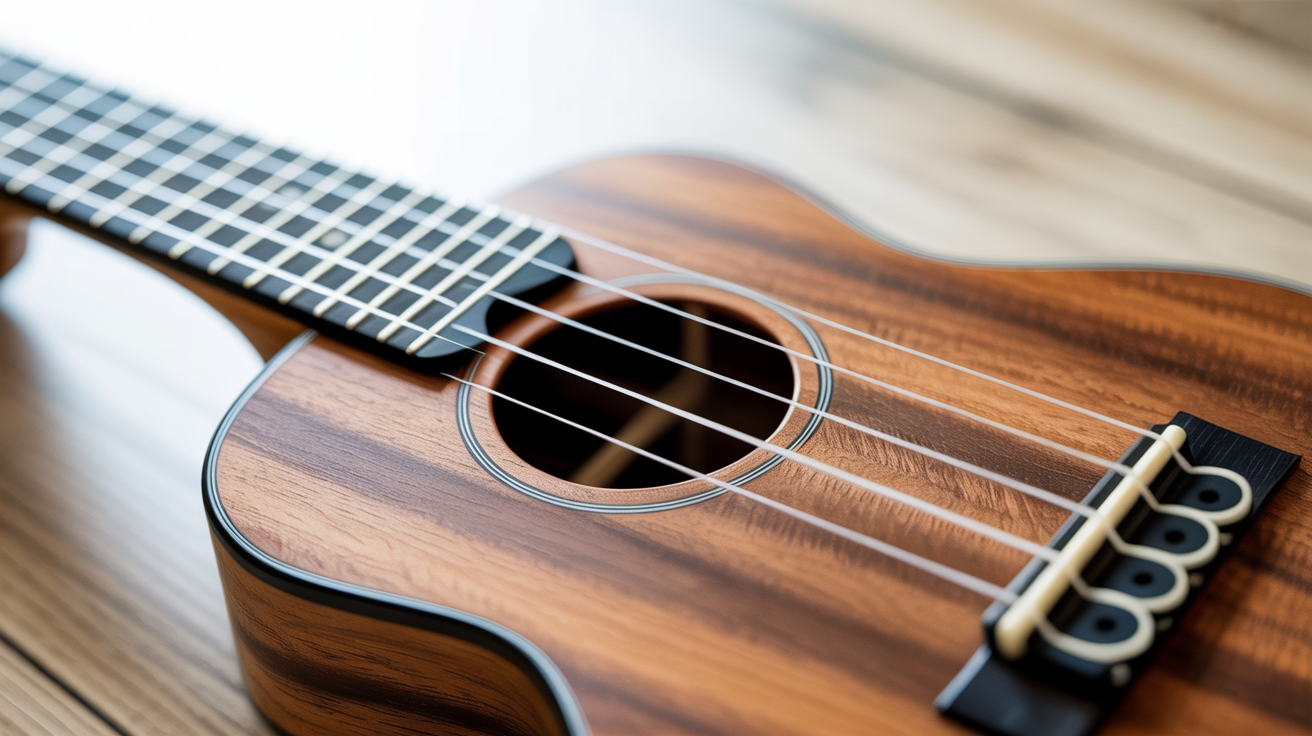
The four strings on a standard ukulele are tuned to g, C, E, and A. That order runs from the string closest to your face (or the ceiling, if you're holding the uke upright) down to the string nearest the floor. Before you touch a chord shape or a tuner, knowing these four letters will make everything else, tuning, reading chord diagrams, making sense of tabs, click into place.
One thing trips up almost every beginner: the string you'd expect to be the lowest-pitched is actually the highest. More on that quirk in a moment, because it's genuinely interesting and not just a weird accident of history.
The Four Strings at a Glance
Here's the full picture, laid out so you can refer back to it anytime:
| String number | Note | Position (uke held upright) | Relative pitch |
|---|---|---|---|
| 4th | g | Closest to your face / ceiling | HIGH (re-entrant) |
| 3rd | C | Second from top | Lowest pitch overall |
| 2nd | E | Second from bottom | Mid-range |
| 1st | A | Closest to the floor | High |
String numbering starts at the bottom (the string nearest your feet is string 1, the A string) and counts up to the top (string 4, the g string). Chord diagrams follow this same numbering, so it's worth locking in now.
Why the g Is Written Lowercase
You'll notice that "g" is lowercase in gCEA while the other three letters are uppercase. That's not a typo, it's a signal.
The lowercase g tells you this string is re-entrant. Instead of following the pattern you'd find on a guitar (where strings get progressively lower as you move toward the ceiling), the top string on a ukulele is tuned up to a high g4. It sits above the C and E strings in pitch, even though it's physically above them on the instrument.
This re-entrant tuning is the main reason the ukulele has that bright, chimey, almost tropical sound. Strum a chord and you get a ping on the top string instead of a bass thud. It gives every strum a kind of built-in sparkle that a standard guitar doesn't naturally produce.
The C string (string 3) is the lowest note on a soprano, concert, or tenor ukulele in standard tuning. If you were to play all four open strings in order from lowest to highest pitch, the sequence would be: C, E, A, g.
How to Remember the String Names
Mnemonics exist for a reason. Here are two that work well for gCEA:
- Good Children Eat Apples (g–C–E–A, top to bottom)
- Get Cats Eat Apples (same order, easier to picture if you're a cat person)
Say whichever one feels natural a few times while you look at your strings. After a week of playing, the order will be automatic.
If mnemonics aren't your thing, try this physical anchor: pluck the C string (string 3) and hum along. It's the lowest, fullest sound on the instrument. Then go up from there, E, A, and finally pluck string 4, the high g. Feeling the pitch drop back down after the A string is a reliable reminder of the re-entrant quirk.
Tuning Each String to the Right Pitch
Knowing the names is one thing; getting them in tune is another. A clip-on chromatic tuner is the most beginner-friendly option, clip it to the headstock, pluck each string, and turn the tuning peg until the display shows the correct letter with a centered needle or green light.
The target pitches for standard gCEA tuning:
- g string (4th): g4 (the G above middle C)
- C string (3rd): C4 (middle C, the lowest string)
- E string (2nd): E4
- A string (1st): A4
If you're using a tuner app on your phone, make sure it's set to chromatic mode rather than guitar mode, since guitar mode will look for E, A, D, G, B, E and may confuse the display. A chromatic tuner reads whatever note you're closest to, which works perfectly for any instrument.
For a broader look at how to set up your instrument before your first session, see how to start playing the ukulele, a beginner's guide.
Tuning Peg Direction
Which way to turn the pegs varies by headstock style. As a general rule: tune up to a note rather than down. If you've overshot your target pitch, drop below it and approach from underneath. This reduces slippage and helps the string settle faster.
Other Tunings You Might Encounter
Standard gCEA is where you should start, and honestly where most players stay. But two alternatives come up often enough that it's useful to know they exist.
Low-G Tuning
Low-G tuning swaps the re-entrant high g string for a wound string tuned down to G3 (the G below middle C). The result is a fuller, more guitar-like range, you get a proper bass note on the top string instead of the bright high g.
Low-G is popular for fingerpicking styles and for players who want more melodic range. It's not better or worse than re-entrant; it's a different tool. Many people keep one uke in each tuning.
Baritone Tuning (DGBE)
The baritone ukulele uses an entirely different tuning: D, G, B, E (low to high). That happens to be the same as the bottom four strings of a guitar, which makes baritone an easier transition for guitar players.
Because the tuning is different, chord shapes for gCEA don't transfer to baritone. If you're learning from standard uke resources, make sure you're playing a soprano, concert, or tenor, not a baritone. The ukulele sizes explained guide covers the differences in detail if you're sorting out which instrument you have.
Reading Chord Diagrams With the String Names in Mind
Once you know that string 1 is A and string 4 is g, chord diagrams start to make sense. A chord diagram shows a grid where vertical lines represent strings and horizontal lines represent frets. String 1 (A) is always on the right, string 4 (g) is on the left.
Dots on the diagram show where to press your fingers. An open circle at the top of a string means you play it open (unfretted). This orientation matches what you see when you look straight at the front of your instrument, string 4 (g) is closest to you, string 1 (A) is farthest.
Getting comfortable with that mental map early on saves a lot of confusion later. For a physical foundation that makes chord pressing easier, take a look at how to hold a ukulele correctly, hand position affects how cleanly the strings ring out.
FAQ
What are the ukulele string names in order?
From the string closest to your face (or the ceiling) to the string closest to the floor, they are: g, C, E, A. String numbers run the opposite direction, string 1 is the A string at the bottom, string 4 is the g string at the top.
Why is the g string tuned so high?
Standard ukulele tuning is re-entrant, meaning the strings don't follow a low-to-high progression from top to bottom like a guitar does. The g string (string 4) is tuned up to g4, which sits higher in pitch than the C and E strings below it. This re-entrant arrangement is what gives the ukulele its bright, ringing character.
Which ukulele string is the lowest in pitch?
The C string (string 3, second from the top) is the lowest-pitched string in standard gCEA tuning. It's tuned to middle C, or C4.
What is the difference between re-entrant and low-G tuning?
In re-entrant (standard) tuning, the g string is tuned high, g4, above both C and E. In low-G tuning, that same string is replaced with a wound string tuned down to G3, giving the instrument a deeper range and a more guitar-like sound. Low-G requires a different string; you can't just loosen your current g string down to that pitch.
Does the tuning change on different ukulele sizes?
Soprano, concert, and tenor ukuleles all use the same standard gCEA tuning. Baritone ukuleles use DGBE tuning instead, which matches the top four strings of a guitar. If you're using a soprano, concert, or tenor, any gCEA chord chart or tab you find online will apply directly to your instrument.