How to Hold a Ukulele Correctly (Sitting and Standing)
Learn proper ukulele holding position for sitting and standing. Get your posture right from day one so your fretting hand stays free and comfortable.
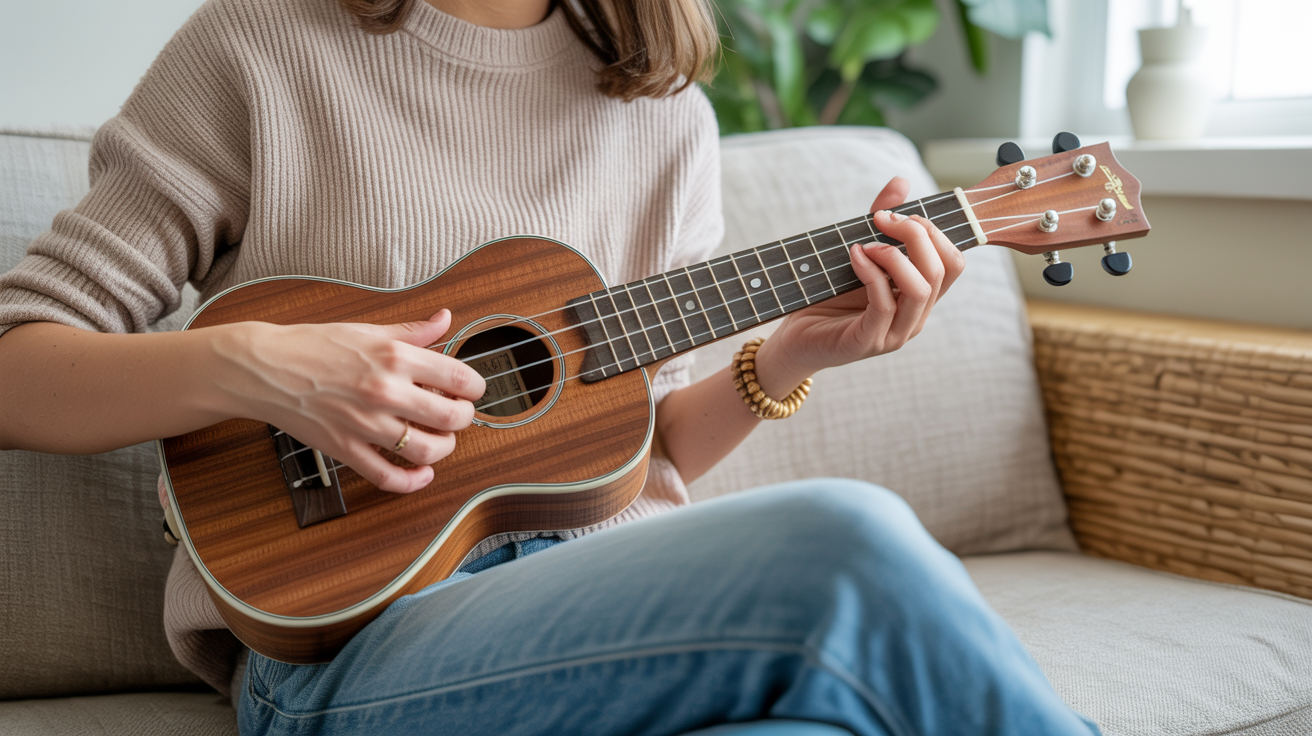
Good posture is probably the least glamorous topic in ukulele playing. It is also the one that trips up more beginners than tricky chords do. Get it right early and your fretting hand will move freely, your wrist will stay relaxed, and you will not develop the mystery aches that make people quit in their third week.
The core idea is simple: your strumming arm does the holding, not your fretting hand. Once you understand that, everything else falls into place.
At a Glance
- Your strumming forearm holds the uke in place. Your fretting hand should never grip the neck to keep it from sliding.
- Sit upright, rest the body on your strumming-side thigh, and angle the neck up 30 to 45 degrees rather than flat.
- Standing without a strap works, but a strap is close to essential for sopranos and makes standing comfortable on any size.
- A strap should sit so the body rests around belly-button height, not so low that your strumming wrist has to bend.
- If your fretting hand can lift off the neck without the uke moving, your position is correct.
- Shoulder, wrist, or neck tension after a few minutes of playing is a sign your setup needs adjusting, not something to push through.
The Golden Rule of Ukulele Holding
Your fretting hand has one job, pressing strings. It should never be responsible for keeping the instrument from falling. The moment it has to grip the neck tightly to stop the uke sliding, your chord changes slow down and your wrist angle goes wrong.
Your strumming forearm is what secures the body of the instrument. Think of it as a gentle hug: the rounded lower bout of the uke rests against your ribs and chest, and your forearm presses lightly on the top edge of the body, trapping it in place. Once that arm is in position, your fretting hand can float along the neck freely.
This is the same principle classical guitarists learn on day one, and it applies equally to the different ukulele sizes. Tenor and concert bodies have more surface area, so they anchor a little more naturally. A soprano is smaller and slipperier, which is why sopranos especially benefit from a strap.
Sitting Position
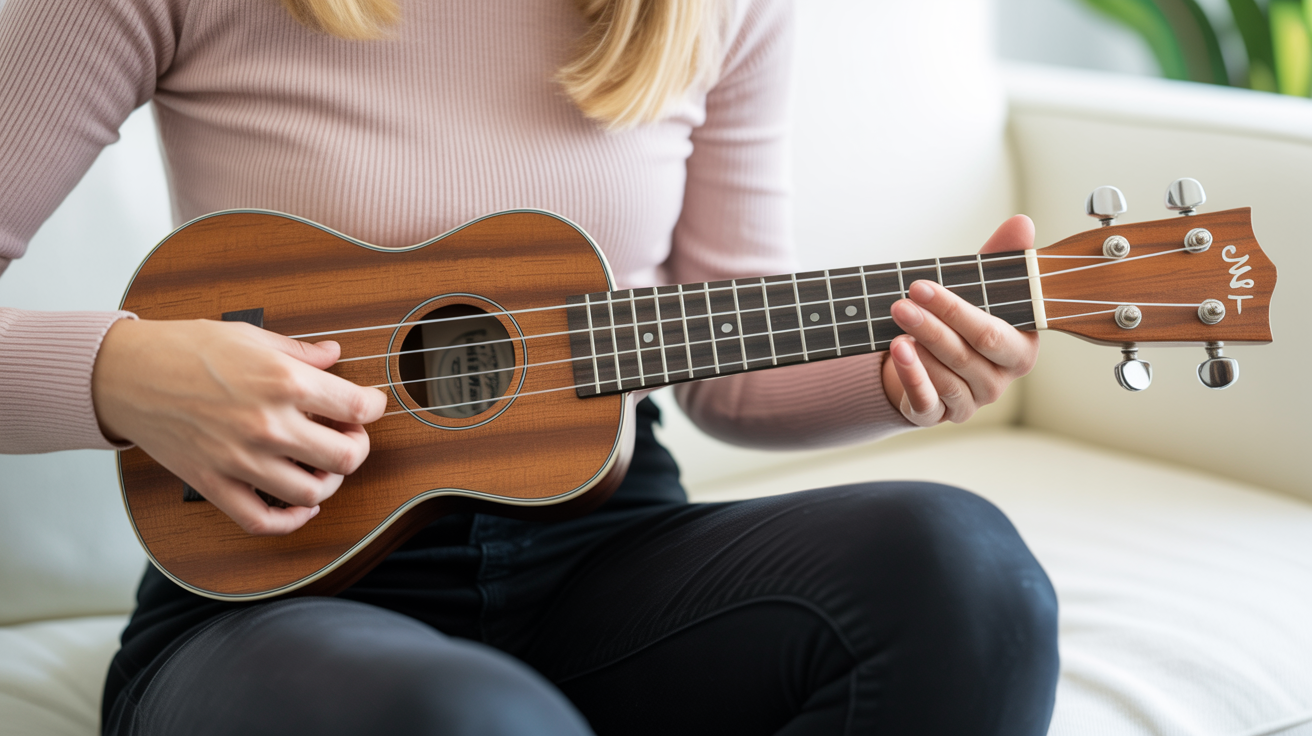
Sitting is the easiest place to start, partly because you have your lap as a secondary support and there is no strap to fuss with.
Setting Up the Sitting Position
- Sit upright on a chair without leaning against the backrest. Slouching caves your chest in and makes it harder to anchor the uke body properly.
- Rest the lower bout on the thigh of your strumming side (right thigh if you strum right-handed). The uke can tilt slightly inward toward your body.
- Bring your strumming forearm over the top of the body, pressing gently so the uke is sandwiched between your arm and your torso.
- Angle the neck upward at roughly 30 to 45 degrees. Dead horizontal is a common beginner habit and it tends to collapse the fretting wrist into an uncomfortable position.
- Let your fretting hand come up to the neck. Your thumb should rest behind the neck, roughly opposite your middle finger, with the pad of the thumb (not the tip) making contact.
What to Check
- Can you lift your fretting hand entirely off the neck and the uke stays put? It should. If it wobbles, your strumming arm needs to press a little more firmly.
- Is your fretting wrist straight or only very slightly bent? A wrist that curls sharply under the neck usually means the neck is angled too flat.
- Are your fretting fingers curling naturally toward the strings, not lying flat? Flat fingers accidentally mute neighboring strings.
Standing Position
Standing requires a bit more setup, but it opens up a lot of freedom once you are used to it. Most players eventually prefer to stand, especially on stage or when playing with others.
Why a Strap Helps So Much
Without a strap, you are relying entirely on your strumming arm to hold the uke. That works, but it limits how much your strumming arm can swing freely. A strap takes the weight and lets both arms focus on playing rather than holding.
Sopranos, being the smallest and lightest size in the ukulele family, have the least body mass to anchor against, a strap is basically essential if you want to stand comfortably. Concert and tenor bodies are easier to anchor without one, but a strap still helps.
See the guide to ukulele parts explained for beginners if you are not sure where strap buttons attach on your instrument, not all ukuleles come with them installed, and some players use a tie-on style that loops around the headstock.
Setting Up the Standing Position
- Attach your strap and adjust it so the uke body sits roughly at your belly button or slightly above. Too low and your strumming wrist bends awkwardly; too high and the strumming angle becomes cramped.
- Even with a strap, keep your strumming forearm lightly in contact with the top of the body. The strap handles vertical support; your arm handles the tilt.
- Keep the neck angled upward, just as you would sitting. The neck should never point downward.
- Check your fretting thumb: it should still sit comfortably behind the neck, not hooked over the top edge.
Playing Without a Strap While Standing
It is possible but takes practice. You press the body firmly against your chest with your strumming forearm, and your upper arm keeps it close. Some players find that a concert-size uke in this position is quite secure because the body has enough surface area to brace against the ribs. Sopranos, again, are the tricky ones.
If you go strapless while standing, check frequently that your fretting hand has not started gripping the neck. It is an easy habit to drift into.
Sitting vs. Standing: Quick Reference
| Setup | What Supports the Uke | Ideal Neck Angle | Strap Needed? |
|---|---|---|---|
| Sitting | Thigh plus strumming forearm | 30–45° upward | Optional, helpful for sopranos |
| Standing, with strap | Strap plus light forearm contact | 30–45° upward | Recommended for all sizes |
| Standing, no strap | Strumming forearm and chest only | 30–45° upward | Not used; requires more forearm pressure |
Common Holding Mistakes
Most beginners land on one or more of these before they get comfortable. Recognizing them early saves a lot of frustration.
| Mistake | What it looks like | Why it's a problem |
|---|---|---|
| Gripping with the fretting hand | Thumb hooks over the top, knuckles white | Slows chord changes, strains the wrist |
| Neck pointing flat or downward | Uke held like a tray | Forces the fretting wrist into an awkward angle |
| Slouching | Rounded back, uke tilted away from the body | Hard to anchor the body; uke slides |
| Strumming elbow doing all the work | No forearm contact with the uke body | Uke wobbles on every strum |
| Fretting fingers lying flat | Fingertips not curling toward strings | Adjacent strings get muted accidentally |
Why Posture Prevents Injuries, Not Just Discomfort
This part is not just about looking relaxed. Research on musicians who develop playing-related musculoskeletal disorders backs up why posture is worth getting right from the start. A 2010 study published in the Journal of Manipulative and Physiological Therapeutics found that impairments in postural stabilization were present in the large majority of musicians studied who had playing-related musculoskeletal pain, concluding that weaknesses in how the body stabilizes itself play an important role in how that pain develops. In other words, the strain does not usually come from the instrument itself; it comes from compensating for poor support with muscles that were never meant to hold that load, like a fretting hand clenched around the neck for an hour.
This tracks with what's understood more broadly about repetitive strain. Repetitive strain injuries develop gradually from sustained tension and awkward positioning repeated over time, and modifying posture and arm use is a standard part of managing them once symptoms appear. For a ukulele player, that means the habits in this guide, forearm anchoring instead of hand gripping, a neutral wrist, a neck angled up rather than flat, are not just about sounding smoother. They are what keeps ten-minute practice sessions from turning into a sore wrist by week three.
Tuning Before You Practice
Every time you sit down to practice, check your tuning first. Standard ukulele tuning is gCEA, from string four to string one. The g (top string) is actually tuned higher than the C and E below it, a re-entrant tuning that gives the instrument its characteristic bright, ringy sound. If you are not sure how the tuning works yet, the beginner's guide to starting ukulele covers this in more depth.
A uke that slips out of tune between sessions is normal, especially on a new instrument when strings are still stretching. Playing in correct position helps because a consistently relaxed grip means you are not pulling the neck around and creating extra tension on the strings.
Building Good Habits Over Time
Correct holding position feels strange for the first few sessions. That is just muscle memory adjusting. A few things that help:
- Do a quick posture check at the start of every practice before you play a single chord. Strumming arm on the body? Neck angled up? Fretting hand floating freely?
- Spend one minute per session just strumming open strings with no fretting. This isolates your strumming mechanics and lets you feel whether the uke is properly secured.
- If your shoulder or wrist feels tense after ten minutes of playing, stop and reset your position. Pain is a signal, not something to play through.
- Take a thirty-second break every ten to fifteen minutes during longer sessions. Even correct posture held rigidly for long stretches benefits from small resets.
Progress comes faster than most beginners expect. After a week or two, the correct position will start to feel natural, and you will notice immediately when you drift out of it, which is the sign that good posture has become instinct.
FAQ
Do I need a strap to play ukulele?
Not strictly. Many players hold the uke securely without one, especially while sitting. A strap is most useful for standing, and it is close to essential on a soprano, which has a small body that is harder to anchor with the forearm alone. If you plan to play standing at all, a strap is worth getting.
My ukulele keeps sliding down. What am I doing wrong?
Usually it means the strumming forearm is not pressing firmly enough on the top edge of the body, or the neck is angled flat rather than slightly upward. Try increasing the forearm pressure just a little and tilting the headstock up. The uke should feel stable without any help from your fretting hand.
Should my thumb go behind the neck or over the top?
Behind the neck, for beginners. The thumb should sit roughly behind your middle finger, with the pad (not the tip) resting on the back of the neck. Hooking the thumb over the top is a habit that limits how far your fingers can reach across the fretboard, especially on the higher frets.
Where should I feel tension when I'm playing?
Ideally, nowhere. Playing should feel relatively relaxed. Light engagement in your strumming forearm as it holds the body is fine, and your fretting fingertips will feel some pressure from the strings. But your shoulder, wrist, and neck should not feel strained. If they do, that is a sign of something off in your position, usually the strumming arm or the neck angle.
Can I play sitting cross-legged on the floor?
Yes, though you may find it harder to keep the neck angled upward, and the uke has less to rest against without a thigh to anchor it. If you sit on the floor often, a strap helps a lot, it maintains the position without you having to compensate with your strumming arm.
Is wrist or shoulder soreness after practicing normal?
A little fatigue after a longer-than-usual session can happen to anyone. Actual soreness that shows up session after session is not normal and usually traces back to gripping the neck, a flat neck angle, or hunching forward to see the fretboard. Reset your position for a few sessions before assuming it is just something you have to push through; it almost never is.