How to Start Playing the Ukulele: A Beginner's Guide
Ready to learn ukulele from scratch? This beginner's guide covers picking your first uke, tuning, holding it right, and playing your first chords.
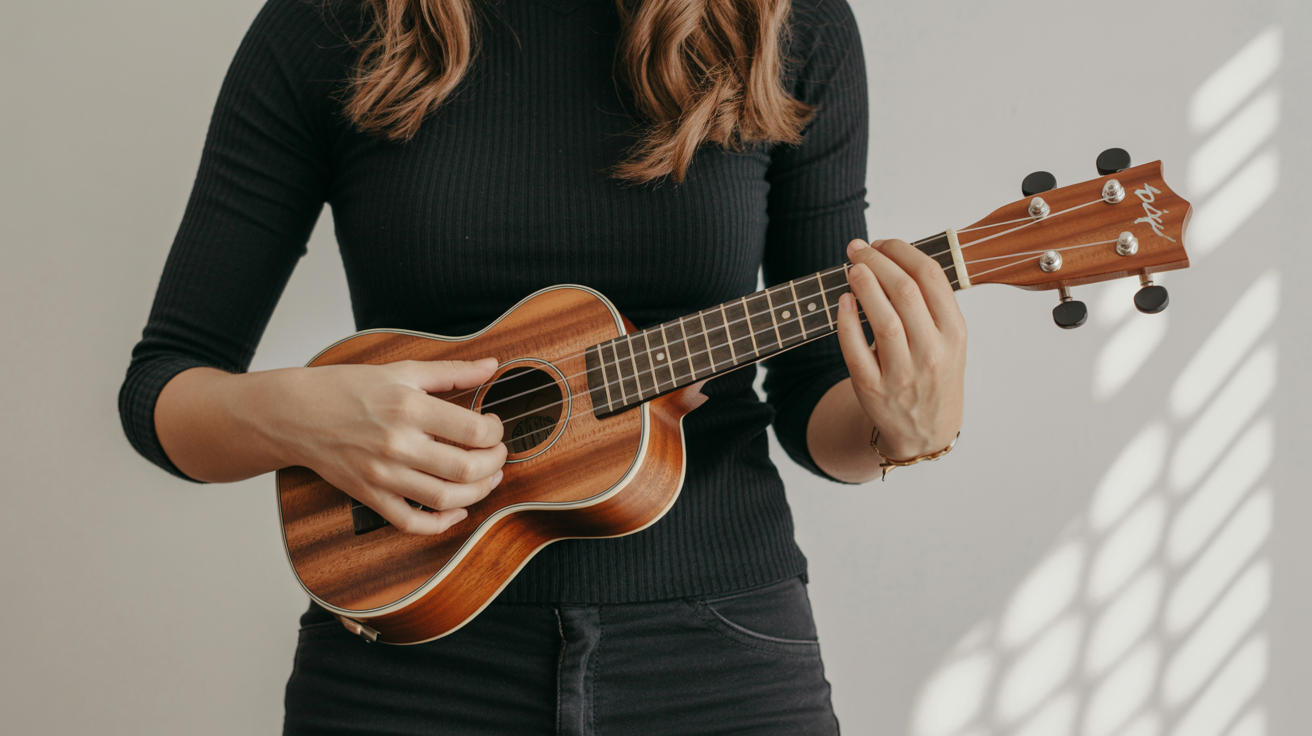
The ukulele is one of the friendliest instruments you can pick up. Four strings, a compact body, and chords that beginners can learn in a single afternoon, it genuinely earns its reputation as the instrument that gets you playing songs fast. This guide walks you through everything you need to go from "never touched a uke" to strumming your first real song.
Choosing Your First Ukulele
Before you play a single note, you need an instrument. Ukuleles come in four main sizes, and the choice matters more than most beginners expect.
For a detailed breakdown of every size, check out our guide to ukulele sizes, soprano, concert, tenor, and baritone. But here's the short version:
- Soprano, The smallest and most iconic. Bright, punchy sound, very portable. String spacing is tight, which can feel cramped if you have larger hands.
- Concert, A step up in body size and volume. Most beginners find it more comfortable than soprano without losing that classic uke tone.
- Tenor, Bigger still, with a fuller, warmer sound and more room between the frets. Popular with players who come from a guitar background.
- Baritone, The largest, and tuned differently (DGBE, like the top four strings of a guitar). Not the best starting point for most absolute beginners.
For most people starting from scratch, a concert or tenor ukulele is the easiest to learn on. Sopranos are charming but the narrower fretboard can slow down chord changes in the early weeks.
What to Look For
You don't need to spend a fortune on a first uke, but you do want an instrument that holds its tuning and has decent action (the gap between strings and fretboard). High action makes pressing down chords genuinely painful and discourages practice. Low action with a properly set nut and saddle makes everything easier.
A solid-top ukulele (even at a modest price point) will generally sound better and project more warmth than an all-laminate model. Read reviews, buy from a music shop if you can (so someone can check the setup before you take it home), and avoid the very cheapest novelty ukuleles that show up in non-music retail stores. They often can't hold tuning, which makes practicing frustrating rather than fun.
Tuning Your Ukulele
Standard ukulele tuning is gCEA. That's G, C, E, and A from the string closest to your chin down to the string closest to the floor. Here's something that surprises new players: the G string (the top string when you're holding the uke) is actually tuned higher in pitch than the C string below it. This is called re-entrant tuning, and it's part of what gives the ukulele its cheerful, bright character.
The exact pitches are: g4 (G above middle C), C4 (middle C), E4, A4.
Getting in Tune
A clip-on chromatic tuner is the easiest solution for a beginner. Clip it to the headstock, pluck each string, and watch the display. These are inexpensive and accurate, and they work in noisy rooms. Free tuner apps work fine in a quiet space if you'd rather not buy anything yet.
To tune each string:
- G string (top, re-entrant high G)
- C string (lowest in pitch)
- E string
- A string (bottom)
New strings go out of tune quickly because they're still stretching. During your first week or two, check the tuning before every practice session. It'll stabilize.
How to Hold the Ukulele
Holding the uke correctly from the start saves you a lot of trouble later. Bad posture creates tension in the wrist and shoulder, which slows down your playing and can lead to soreness.
For a full walkthrough, see how to hold a ukulele correctly when sitting and standing. The key points:
Sitting: Rest the body of the uke on your strumming-hand forearm, pressing it gently against your chest or rib cage. The neck angles slightly upward. Your fretting hand holds the neck, it doesn't support the body weight.
Standing: Use your strumming-arm forearm to clamp the uke against your body. A strap helps, especially with tenor and baritone ukuleles.
The fretting hand should have a relaxed curve, thumb resting on the back of the neck (not hooking over the top). Fingers press the strings just behind the fret wire, not on top of it and not halfway back in the fret space.
Learning Your First Chords
This is where the ukulele really shines for beginners. Four chords will get you through hundreds of songs, and three of those four are genuinely easy.
The Essential Starting Chords
| Chord | Fret positions (G-C-E-A) | Difficulty |
|---|---|---|
| C | 0-0-0-3 | Very easy, one finger |
| Am | 2-0-0-0 | Very easy, one finger |
| F | 2-0-1-0 | Easy, two fingers |
| G7 | 0-2-1-2 | Moderate, three fingers |
The C chord is often the very first chord taught because it uses just one finger, your ring finger on the third fret of the A string, and all other strings open. Strum it and you'll hear a full, resonant chord right away.
Am is equally simple: one finger on the second fret of the G string. F adds a second finger. G7 uses three fingers and is the first one that takes real practice to get cleanly.
Practice Tips for Chord Changes
Chord shapes themselves aren't the hard part. Switching between them smoothly is. A few things that help:
- Practice "anchor fingers", if a finger stays on the same string between two chords, keep it planted and move only the other fingers.
- Do slow, deliberate changes at first. Speed comes from accuracy, not from rushing.
- Practice a transition 10-20 times in a row before moving on. Repetition builds muscle memory faster than variety.
- Use a timer and set a 5-minute goal for each chord pair. It's more effective than vague noodling.
Strumming Patterns for Beginners
You can play songs with just a single downstroke on every beat, and that's a perfectly fine starting point. But once your chord changes feel solid, a simple strumming pattern adds a lot of life.
The most common beginner pattern is sometimes called the island strum:
D, D-U, U-D-U
D = downstroke, U = upstroke. Counted over four beats, it sounds like:
1 (D), 2-and (D-U), and-3-and (U-D-U)
Use the nail side of your index finger for downstrokes and the pad for upstrokes, or brush with the nail both ways. Keep your wrist relaxed and fluid, stiff strumming sounds mechanical.
Start with the pattern at half speed, keeping the chord the same throughout. Once that's easy, try switching chords while maintaining the pattern. The chord changes are harder than the strum itself.
Getting Parts of the Ukulele Straight
Understanding the instrument helps you communicate with other players and follow tutorials without confusion. The parts of a ukulele explained for beginners covers everything in detail, but here's a quick orientation:
- Headstock, the flat piece at the top where the tuning pegs live
- Nut, the small slotted piece at the base of the headstock that guides the strings
- Neck, the long piece your fretting hand wraps around
- Frets, the metal strips on the fretboard; pressing a string behind one raises its pitch
- Body, the hollow wooden resonating chamber
- Soundhole, the circular opening that projects sound
- Bridge and saddle, at the base of the body, where the strings anchor
Knowing these terms means you can follow along when a tutorial says "press the third fret of the C string" without any confusion.
Building a Practice Routine
Short, consistent practice beats long, sporadic sessions. Twenty minutes a day five times a week will get you further than a two-hour session on the weekend.
A simple beginner structure:
- Tune up (2 minutes), every session, no exceptions
- Warm up, a few slow chord shapes, making sure each string rings cleanly
- Chord changes (5-7 minutes), pick two chords and practice switching between them
- Strumming (5 minutes), work on a pattern, first with one chord, then with changes
- Song practice (5-10 minutes), apply what you've worked on to an actual song
Songs are the payoff. Even playing something slowly and imperfectly is motivating. Pick a song you genuinely like, even if it's simple. A song you care about is much easier to practice than an exercise you find dull.
FAQ
How long does it take to learn ukulele as a complete beginner?
Most people can play a simple song with two or three chords within their first week of practice, assuming they're practicing a little every day. Getting fluid enough to play through songs without stopping takes most beginners a few months of consistent practice. "Learning ukulele" is an ongoing process, there's always something more to explore, but the early wins come faster on the uke than almost any other instrument.
Do I need to read music to play ukulele?
No. Most ukulele players use chord diagrams and tablature (tabs), not standard notation. Chord diagrams show you where to place your fingers on a grid representing the fretboard. Tabs show you which frets to press on which strings for melodies. Both are easy to read with a ten-minute introduction, and the vast majority of beginner tutorials use them.
What's the easiest song to learn on ukulele?
Songs built on just C and Am (or C and G) are the easiest starting points. Classics like "Somewhere Over the Rainbow" and "You Are My Sunshine" use a small handful of chords and slow chord changes, which gives you time to think. "Riptide" by Vance Joy (Am, G, C) has become a common first-song goal for beginners. Pick whatever motivates you, that matters more than the specific song.
Should I use a pick or my fingers?
Most ukulele players strum with their fingers, specifically the nail side of the index finger or a combination of index and thumb. A felt pick is the closest thing to a traditional pick that works on ukulele, since hard plastic picks can produce a harsh tone on nylon strings. Start with your fingers, it's the most natural sound for the instrument.
My fingers hurt after practicing. Is that normal?
Some soreness in the fingertips is normal for the first week or two while your skin toughens up. Sharp pain in your wrist, forearm, or shoulder is a warning sign that something in your posture or technique needs adjusting, usually grip tension. Take breaks, shake out your hands, and review how you're holding the uke. Practice sessions of 15-20 minutes are better for your hands than marathon sessions when you're just starting out.