The Parts of a Ukulele, Explained for Beginners
Learn the names and functions of every part of a ukulele, from headstock to saddle, so you can tune, play, and care for your instrument with confidence.
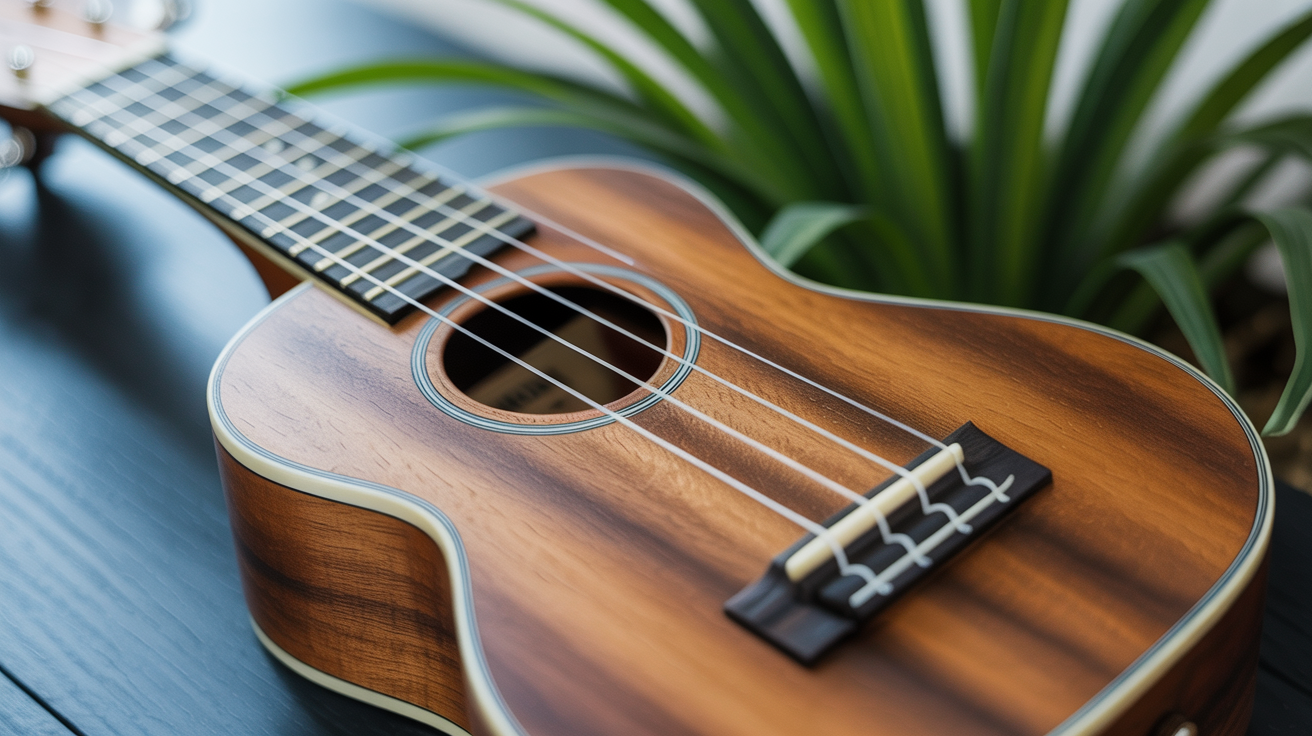
Pick up a ukulele for the first time and it looks pretty simple: four strings, a smallish body, a skinny neck. But once a teacher or a YouTube tutorial starts rattling off words like "nut," "saddle," and "fretboard," that simplicity can evaporate fast. Knowing what each part is called and what it actually does makes everything else easier: tuning, holding the instrument correctly, buying strings, even describing a problem to someone at a music shop. This guide walks through every part of a ukulele in plain language, from the top of the instrument down to where the strings end.
At a Glance
- The headstock holds the tuning machines; the nut spaces the strings and sets their height at that end of the neck.
- Frets divide the neck into half-steps; the dots you see are fret markers, just a visual reference, not a structural part.
- The soundboard (the top of the body) does most of the work turning string vibration into audible sound.
- The bridge anchors the strings to the body; the saddle sitting on top of it sets string height and spacing at that end.
- Standard tuning is gCEA, with the g string pitched an octave higher than you'd expect. This is called re-entrant tuning.
- Nothing here is required knowledge to play your first chord, but it pays off the first time something buzzes, slips, or needs adjusting.
The Headstock
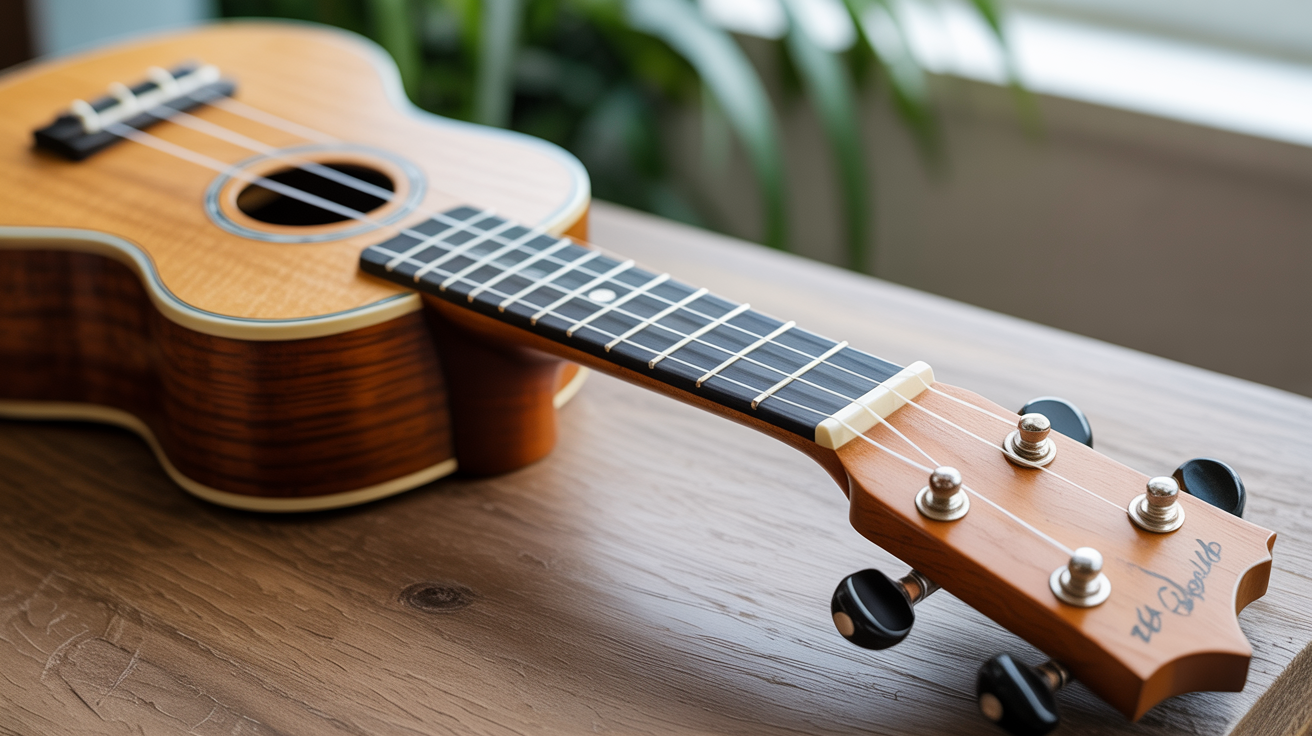
The headstock is the flat, paddle-shaped piece at the very top of the ukulele. Its one job is to hold the tuning machines in place. You'll see it on every ukulele regardless of size (soprano, concert, tenor, or baritone). Some headstocks are slotted, meaning open on the sides so the tuning posts sit between two "walls," and some are solid with the posts poking out. Both work exactly the same way; it's purely a design choice.
Tuning Machines (Tuning Pegs / Machine Heads)
The tuning machines, also called tuning pegs or machine heads, are the small geared knobs you turn to tighten or loosen each string. Tightening raises the pitch; loosening drops it. Most modern ukuleles have friction tuners or geared tuners. Geared tuners have a worm-gear mechanism inside that gives you finer control and tends to hold pitch more reliably, which is a real advantage when you're still getting a feel for how much to turn. A typical geared tuner has somewhere around a 4:1 or 14:1 ratio, meaning you turn the knob several full rotations to move the post one rotation, which is what makes fine pitch adjustments possible without overshooting. Friction tuners are simpler and lighter but can slip if the adjustment screw gets loose.
The Nut
Right where the headstock meets the neck, you'll find a thin slotted piece sitting crosswise on the fretboard. That's the nut. According to the Wikipedia entry on the nut, the nut "marks one end of the vibrating length of each open string, sets the spacing of the strings across the neck, and usually holds the strings at the proper height from the fingerboard." In practice, that means it has four small grooves, one for each string, cut to keep them spaced evenly and just high enough to clear the frets as they travel from the headstock onto the fretboard. A poorly cut nut (slots too high, or unevenly spaced) can make a ukulele harder to play than it needs to be, so it's worth knowing it exists even if you never need to think about it again.
The Neck and Fretboard
The neck is the long strip of wood that connects the headstock to the body. You wrap your fretting hand around it when you play chords. Glued or inlaid onto the flat face of the neck is the fretboard (also called the fingerboard), usually a darker, denser wood like walnut, ebony, or a synthetic substitute.
Frets
Frets are the thin metal strips embedded at measured intervals along the fretboard. Each fret represents one musical half-step, and each fret is spaced slightly closer together than the one before it as you move toward the body, following the same mathematical ratio used on every fretted instrument. When you press a string down just behind a fret (between two fret wires, closer to the one toward the body), you shorten the vibrating length of the string and raise its pitch. Twelve frets up from an open string gets you exactly one octave higher, which is why the 12th fret is almost always marked with a double dot.
A standard soprano ukulele has around 12 to 15 frets; concert and tenor models usually have more, since their longer necks leave room for extra frets before the neck meets the body. Here's how fret count and scale length (the distance from nut to saddle) typically break down by size:
| Size | Typical Scale Length | Typical Fret Count |
|---|---|---|
| Soprano | ~13 in | 12–15 |
| Concert | ~15 in | 15–18 |
| Tenor | ~17 in | 17–19 |
| Baritone | ~19 in | 18–21 |
More frets don't necessarily mean a better instrument; they mostly mean more room to play higher up the neck, which matters more for melody playing and soloing than for strumming chords low on the neck. If you're deciding between sizes, our full comparison of ukulele sizes goes into how the extra length changes feel and tone, not just fret count.
Fret Markers
Look at the fretboard from the front and you'll notice small dots inlaid at certain frets, typically frets 5, 7, 10, and 12. These are fret markers or position dots. They're orientation guides so you can glance down and immediately know where you are on the neck without counting every fret from scratch. Many ukuleles also have small side dots on the edge of the neck, which are easier to see when your instrument is in playing position. Fret markers are purely cosmetic and functional as a visual aid; removing them (not that you'd want to) wouldn't change how the instrument plays at all.
The Body
The body is the hollow wooden box that gives the ukulele its sound. It looks like a small guitar body and does the same core work: amplifying and projecting the vibrations from the strings. The body has three surfaces.
Top (Soundboard)
The top, also called the soundboard, is the face of the ukulele. It's the side you look at when you're strumming. It's typically the thinnest part of the body, and it does most of the acoustic heavy lifting. When a string vibrates, it transfers energy through the bridge and saddle into the top, causing it to vibrate and push sound waves into the air. Wikipedia's entry on the soundboard describes the mechanism plainly: as the soundboard moves, it compresses and releases the air in front of it, generating sound waves much the way a loudspeaker cone does, only here the "speaker" is a few thin sheets of wood instead of an electrical driver. That's also why the soundboard has a bigger effect on tone than any other single part: a stiffer top tends to sound brighter and more responsive, while a more flexible one tends to sound warmer and slower to speak.
Back and Sides
The back and sides form the rest of the body's shell. They reflect sound back through the soundhole and help shape the overall volume and projection. On beginner instruments these are usually laminate (thin layers of wood glued together); on higher-end ukuleles they're solid wood. Both work fine for learning, though laminate has a practical advantage most beginners appreciate: it's far more resistant to humidity swings and unlikely to crack if it dries out a little in winter.
Soundhole
The soundhole is the circular opening cut into the center of the soundboard. It lets sound escape from inside the body so it projects outward. It also gives the resonating air inside the body somewhere to move, which reinforces certain low frequencies (an effect luthiers call the "air resonance"). Without a soundhole, the ukulele would sound much quieter and more muffled, roughly the way an acoustic guitar sounds if you press a hand flat over its hole while strumming.
The Bridge and Saddle
At the bottom of the soundboard, closest to you when the ukulele is in playing position, sits the bridge. The bridge is a small block of wood glued directly to the top of the ukulele. The strings run across it and anchor here, transferring their vibrations into the soundboard.
Saddle
Sitting in a slot on top of the bridge is the saddle: a small white or cream-colored strip, similar to the nut in appearance and function. The strings pass over the saddle on their way from the bridge to the fretboard. Like the nut, it sets the string height (called "action") and keeps strings properly spaced. The distance from the nut to the saddle determines the instrument's scale length, which is why the two are always mentioned together when discussing intonation. A saddle that's a fraction of a millimeter too tall or too short is often the real cause behind a ukulele that plays slightly sharp or flat higher up the neck, even when the open strings read perfectly in tune.
The Strings
A standard ukulele has four strings, tuned g-C-E-A. That's measured from the string closest to the ceiling when you're holding the instrument in playing position. This is called gCEA tuning, and it's also sometimes called re-entrant tuning because the g string is tuned up an octave rather than being the lowest-pitched string. Wikipedia's entry on the ukulele confirms this is the standard arrangement for a soprano-tuned instrument, noting that the G string is "tuned an octave higher than might be expected," which is what makes the tuning re-entrant rather than a simple low-to-high progression like a guitar's. That high g is part of what gives the ukulele its bright, cheerful character. Strings are most commonly made from nylon or fluorocarbon, which feel softer under the fingers than steel strings and are gentler for beginners.
Quick Reference: All the Parts at a Glance
| Part | Location | What It Does |
|---|---|---|
| Headstock | Top of the instrument | Holds the tuning machines |
| Tuning machines | On the headstock | Tighten/loosen strings to tune |
| Nut | Top of the fretboard | Spaces and guides strings from headstock |
| Neck | Between headstock and body | Structure for the fretboard; fretting hand grips here |
| Fretboard | Flat face of the neck | Surface where you press strings |
| Frets | Metal strips on fretboard | Divide the neck into half-steps |
| Fret markers | Dots on the fretboard | Position reference points |
| Body | The main wooden box | Resonates and projects sound |
| Soundboard (top) | Front face of body | Primary sound amplifier |
| Back and sides | Rest of the body shell | Enclose the resonating air |
| Soundhole | Circular opening in top | Lets sound project outward |
| Bridge | Bottom of soundboard | Anchors strings, transfers vibration to top |
| Saddle | Sits in bridge slot | Sets string height and spacing at the body end |
| Strings (x4) | Run full length of instrument | Vibrate to produce pitch |
FAQ
Why does it matter what the parts are called?
Practically speaking, you'll encounter these terms constantly: in chord charts, tuning apps, instructional videos, and conversations at a music shop. Knowing that the "nut" is at the top of the neck and the "saddle" is at the bottom means you won't have to pause and decode every sentence while you're trying to learn something else. It also helps you describe problems clearly, like "the string keeps slipping out of the nut slot" versus a vague "something's wrong at the top."
What is action on a ukulele?
Action refers to the height of the strings above the fretboard. It's set mainly by the nut and saddle. High action makes the ukulele harder to press down (your fingers have to work more) and can cause chords to sound slightly out of tune even when the open strings are tuned correctly. Low action makes playing easier but can cause strings to buzz against the frets. Most ukuleles from a reputable shop come set up reasonably well, but a simple adjustment at the nut or saddle by a luthier, often shaving a fraction of a millimeter off the saddle, can make a surprising difference for around the cost of a set of strings.
Does the wood type affect how the ukulele sounds?
Yes, though the effect is more noticeable as you move up in price range. Solid mahogany tops tend to produce a warmer, slightly darker tone; solid spruce is brighter and more responsive to dynamics. For a beginner instrument, the build quality and setup matter more than the specific species. If you're curious about how size affects sound, our guide to ukulele sizes covers the differences in a lot more detail.
How do the strings connect to the bridge?
Most ukuleles use a tie-bar bridge: you thread the string through a small hole or slot in the bridge, loop it back, and tie it in a knot that keeps it from pulling through. A few use a pin bridge similar to an acoustic guitar. The type matters most when you're restringing, so always check your specific ukulele's method before you start, and follow the manufacturer's instructions for your instrument.
Why do some ukuleles have 12 frets and others closer to 20?
It comes down to scale length and body size. A soprano's short neck simply runs out of room sooner, so it typically stops around fret 12 to 15. A tenor's longer neck has space for 17 or more frets before it meets the body. Neither is more correct; it's a tradeoff between compactness and range, and it's one of the clearest physical differences between the sizes beyond overall length.
Do I need to know all of this before I play my first chord?
Not at all. You can pick up a ukulele right now and learn a chord without knowing a saddle from a soundhole. A quick once-over of the parts takes about five minutes and pays off for years. When your teacher says "check the nut," you'll know exactly where to look. When a string buzzes, you'll have a starting point for diagnosing why. If you're ready for the next step, how to hold a ukulele correctly is a natural follow-up, and our beginner's guide to getting started covers what comes after that.