Simple Fingerstyle Ukulele Pieces for Beginners
Learn easy fingerstyle ukulele songs with beginner-friendly patterns, tips for training your picking hand, and a starter list of simple ukulele instrumentals.
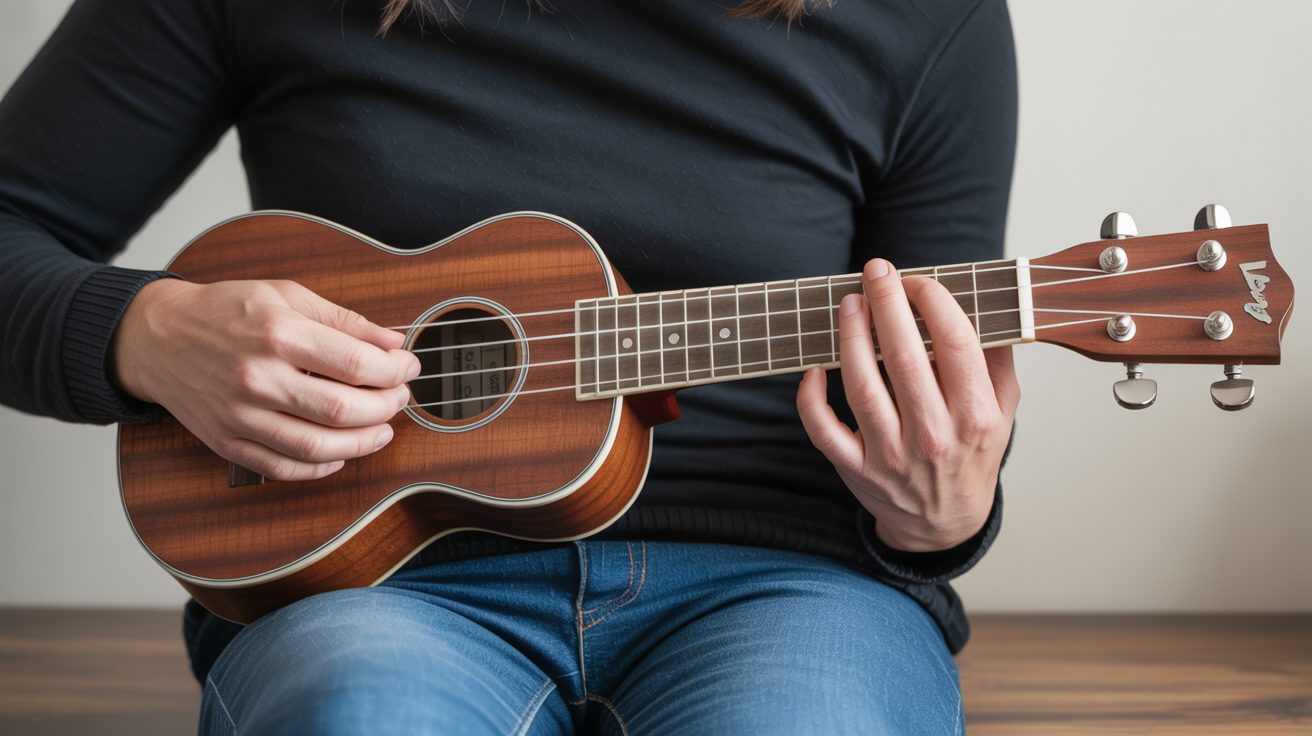
Fingerstyle ukulele means your picking hand does more than strum. Instead of sweeping all four strings at once, individual fingers pluck individual strings, one at a time or in short patterns. The result sounds fuller, more expressive, and often more impressive than it actually is to play. That gap between how it sounds and how hard it is to learn is exactly why fingerstyle is worth exploring early.
You do not need advanced technique to get started. A handful of picking patterns and a short list of beginner-friendly pieces can carry you through the first few months.
How Fingerstyle Differs from Strumming
When you strum, your thumb or index finger sweeps across all four strings in a single motion. Fingerstyle assigns each finger a string (or a group of strings) and lets you pluck them in any order.
On a soprano, concert, or tenor ukulele in standard GCEA tuning, a typical assignment looks like this:
- Thumb: G string (string 4) and C string (string 3)
- Index finger: E string (string 2)
- Middle finger: A string (string 1, the highest)
You do not have to follow that assignment rigidly, but it gives you a starting framework. Once your fingers know where to go without looking, patterns become automatic, and you can focus on tone and rhythm instead of mechanics.
A Basic Picking Pattern to Learn First
Before you try to learn a piece, practice the pattern in isolation on an open chord you already know. The "forward roll" pattern is one of the most beginner-friendly options:
String:  G  C  E  A
Number:  4  3  2  1

Pattern: 4 - 3 - 2 - 1 - 2 - 3 - (repeat)
Play that cycle slowly on a C major chord, letting each note ring into the next. Once you can do it without pausing to figure out which finger goes where, you are ready to apply it to a piece.
A simpler version for absolute beginners:
Pattern: 3 - 2 - 1 - 2 - (repeat)
This four-note loop works over almost any chord and gives you a clean, harp-like sound with very little effort.
Simple Pieces to Start With
The best beginner fingerstyle ukulele pieces share two qualities: they use chords you already know, and the picking pattern stays the same (or nearly the same) throughout. That means you are only learning one new thing at a time.
Traditional and Public-Domain Melodies
Traditional songs with no copyright restrictions make ideal practice material. You can focus on the technique rather than worrying about where to find legal sheet music.
Scarborough Fair (traditional English folk song) -- the melody sits mostly on the A and E strings, which suits ukulele fingerpicking naturally. Play the melody on the top two strings while holding chord shapes underneath.
Greensleeves (anonymous, 16th-century) -- a gentle triple-meter melody in a minor key. Because each phrase is short and predictable, it is easier to memorize than it looks. Learning it forces you to move smoothly between A minor and C major, two chords most beginners already have.
Ode to Joy (main theme, Beethoven) -- the famous melody is built from only a few notes and stays on the higher strings. It teaches you to play a recognizable tune without accompaniment underneath, which builds confidence in your single-string playing.
Amazing Grace (traditional hymn) -- slow tempo, wide intervals, and a singable melody make this one of the most forgiving pieces to start with. The pauses between notes give you time to reposition without rushing.
Simple Gifts (traditional Shaker hymn) -- shorter phrases and a moderate pace; works well as a single-line melody over a drone on the C or G string.
Playing Chord Melodies vs. Single-Line Melodies
There are two main approaches to beginner fingerstyle ukulele:
Single-line melody -- you pick out the tune on the top one or two strings. No chord shapes are strictly required, though holding a chord while you pick the melody adds warmth. This is the easier approach when starting out.
Chord melody -- you play the melody note on top while the other fingers pluck lower strings from a chord shape, all at the same time or in quick succession. This sounds like a full arrangement but is harder to coordinate.
Start with single-line melodies. Once you can play through a piece cleanly from start to finish, try adding the chord underneath. That progression from melody-only to chord-melody is how most self-taught players develop fingerstyle technique.
Training Your Picking Hand
Accuracy matters more than speed in fingerstyle. A few habits established early save a lot of backtracking later.
Rest your arm, not your wrist. Lay your forearm lightly on the top of the body. This stabilizes your hand without muting the strings.
Use your fingernails or fingertips consistently. Some players prefer nails for a crisper tone; others prefer the softer sound of fingertips. Pick one approach and stay with it during a practice session so your touch stays uniform.
Practice without looking. Once you know the string assignment, close your eyes occasionally while running the pattern. Your fingers will learn to find the strings by feel, which is the level of reliability you need when reading tabs or performing.
Go slow enough to get it right. A tempo where you never make mistakes is the fastest way to learn. You can read more about building that foundation in our guide to easy first songs to play on the ukulele.
Reading Tabs for Fingerstyle Pieces
Most beginner fingerstyle ukulele pieces are shared as tabs rather than standard notation. Tabs show you which fret to press on which string without requiring you to read music.
A ukulele tab has four horizontal lines. The top line represents the A string (highest pitch); the bottom line represents the G string. Numbers on each line tell you which fret to press. A zero means open string.
A |--0--3--2--0--|
E |--1--0--0--1--|
C |--0--0--0--0--|
G |--2--0--2--2--|
For fingerstyle pieces, the numbers appear stacked (play them simultaneously) or spread out with space between (pluck them in sequence). Once you understand that distinction, most beginner tabs are straightforward. Our full breakdown is in how to read ukulele tabs.
Moving from Instrumental to Singing Along
Many players learn fingerstyle instrumentals first and then eventually want to add their voice. The coordination challenge is real: your picking hand has to run the pattern on autopilot while your voice carries the melody.
The shortcut is to get the pattern completely automatic before you try to sing. If you have to think about which string comes next, your voice will suffer. Aim to play through the piece at least 20 consecutive times without any errors before you open your mouth to sing. When the pattern is that deeply memorized, adding a vocal line becomes much more manageable. For a more complete approach to that transition, see how to play and sing at the same time on the ukulele.
Frequently Asked Questions
Do I need long fingernails to play fingerstyle ukulele? No. Nails can add brightness to the tone, but they are not required. Many players use the pads of their fingertips and produce a warm, clear sound. If you try nails and find they break or get in the way, fingertips work fine.
Is fingerstyle harder than strumming for a beginner? It requires a different kind of coordination, but it is not necessarily harder. Strumming demands rhythm and timing; fingerstyle demands finger independence. Some beginners find fingerpicking easier because they can go slowly without losing the beat the way they might with a strum pattern.
How long does it take to learn a simple fingerpicking piece? A short traditional melody with a consistent pattern is within reach in one to three weeks of regular practice, assuming 15 to 20 minutes a day. The first piece always takes the longest. After that, the pattern transfers and new pieces come faster.
Can I use a pick for fingerstyle? A flat pick cannot replicate fingerstyle because you only have one point of contact. Some players use a thumb pick plus bare fingers, which is a legitimate technique. For most beginners, however, bare fingers are the simplest place to start.
What ukulele size is best for fingerstyle? Tenor ukuleles have slightly wider string spacing, which gives your fingers more room to land cleanly on individual strings. That said, fingerstyle works on soprano and concert sizes too. Use whatever ukulele you already own. The technique is more important than the size.