How to Read Ukulele Tabs
Learn how to read ukulele tabs from scratch. Understand the four strings, fret numbers, chord stacks, and common symbols — no music theory needed.
Ukulele tab (short for tablature) is a system that tells you exactly where to put your fingers on the fretboard, using numbers instead of musical notes. You don't need to read sheet music. You don't need to know note names. If you can count to twelve and tell left from right, you can use tabs.
Here's the core idea: four horizontal lines represent your four strings, and numbers on those lines tell you which fret to press. That's most of it. The rest is just filling in the details.
At a Glance
- Tab uses four lines (one per string) and numbers (which fret to press); 0 means play the string open.
- Ukulele tab reads A-E-C-g from top to bottom, the reverse of how the strings sit when you hold the instrument.
- Numbers in a single row are a melody played one note at a time; numbers stacked vertically are a chord strummed together.
- Tab shows where to put your fingers but usually not when or how long to hold each note, so you still need to know the tune.
- Hammer-ons (h), pull-offs (p), and slides (/ and ) are the most common symbols you'll run into as a beginner.
- Guitar and ukulele use the same tab format, but the string count and order differ, so a guitar tab won't drop straight onto a uke.
The Four Lines and What They Mean
Every ukulele tab has four horizontal lines, one per string. Reading them can feel backwards at first, so pay close attention here.
The top line is the A string (the thinnest, highest-pitched string). Working down:
A ------
E ------
C ------
g ------
The bottom line is the g string, the one closest to your chin when you hold the uke in playing position. Notice it's a lowercase g. That's the standard way to label it, because the g string is tuned up an octave higher than you'd expect given its position, a quirk called re-entrant tuning. Don't worry about the theory; just remember the order: A, E, C, g from top to bottom.
Standard ukulele tuning is gCEA, meaning the strings are (from bottom to top, as you hold the instrument) g, C, E, A. Tab shows them the other way, A on top, g on the bottom.
Here's that mapping as a quick reference:
| Tab line (top to bottom) | String | Open note | Where it sits on the instrument |
|---|---|---|---|
| Line 1 | A | A | Closest to the floor |
| Line 2 | E | E | Second from the floor |
| Line 3 | C | C | Second from your chin |
| Line 4 | g | G (an octave higher than you'd expect) | Closest to your chin |
Why It Feels Upside Down
Many beginners expect the lowest-pitched string to be at the bottom of the tab, like the lowest string on a guitar. Ukulele tabs flip that expectation. The A string sits on top because it's the string closest to the floor when the uke is in playing position, and tablature is drawn from the player's perspective looking down at the strings. Once you play a few songs, your eye adjusts quickly.
Numbers: Open Strings and Frets
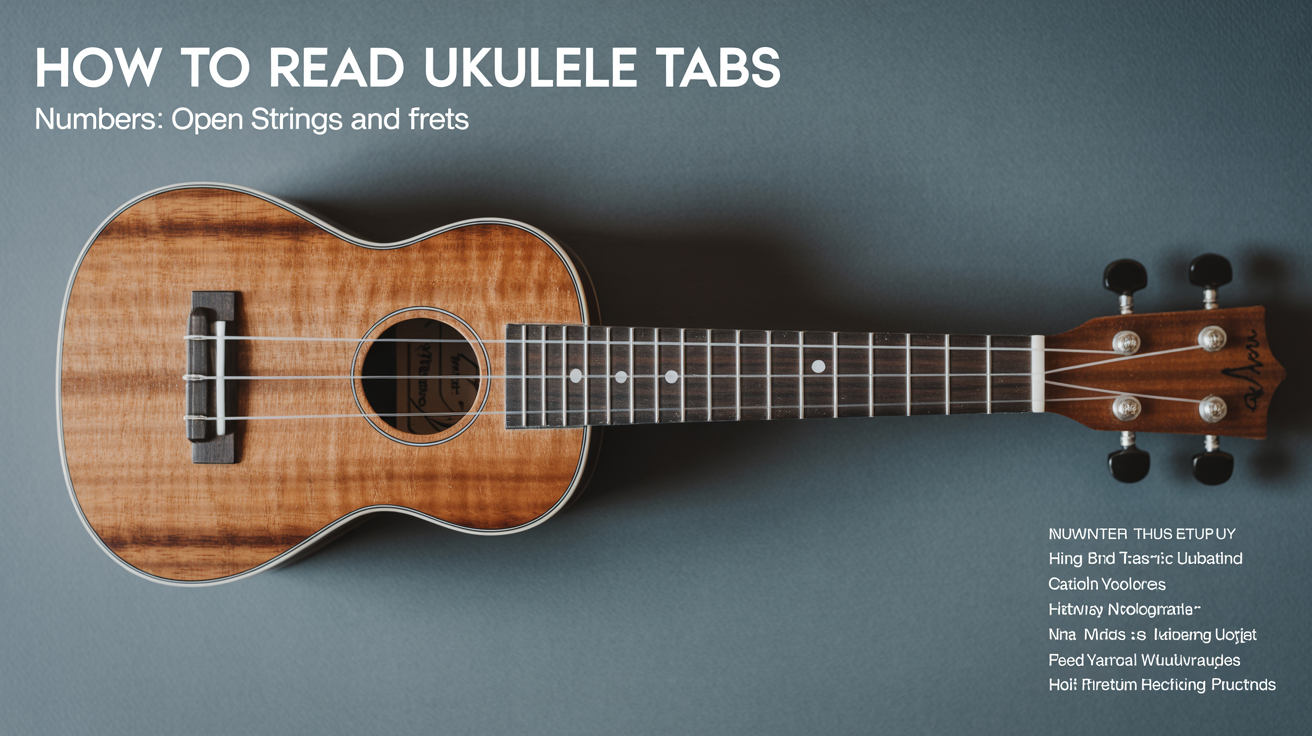
Every number you see on a tab line tells you two things: which string to play (the line it sits on) and which fret to press (the number itself).
- 0 means play the string open, no finger on the fretboard
- 1 means press the first fret
- 2 means press the second fret
- And so on up the neck
Here's a simple example: the opening of a melody on just the A string.
A -0-2-3-5-
E ----------
C ----------
g ----------
Read it left to right. Play the A string open (0), then fret 2, then fret 3, then fret 5. That's it. Each number is one plucked note, played in order.
Reading Melody vs. Chords in Tab
When numbers appear one at a time, you're playing a melody, pick each note separately.
When numbers are stacked vertically, you play them all at once. That's a chord. Here's a C major chord:
A -0-
E -0-
C -0-
g -0-
All four strings open, that's actually not C, that's just an illustration of open strings. Here's a real Am chord:
A -0-
E -0-
C -0-
g -2-
Press fret 2 on the g string and strum all four strings together. Done.
A G major chord looks like this:
A -2-
E -3-
C -2-
g -0-
Three fretted strings, one open. Strum them simultaneously.
What Tab Does and Doesn't Tell You
Tab is incredibly useful, but it has one big limitation: it usually doesn't show rhythm. You see which notes to play and in what order, but not how long to hold each note or how fast to move through them. This is a real, well-documented limit of the format: tablature notation is built to show finger position rather than pitch or duration, which is exactly why it works without any music-reading background, and exactly why it leaves rhythm up to you.
For chord charts (where you're strumming patterns), this rarely matters, you already know the song and the tab just maps the chord shapes. For melody tabs, you'll need to know the tune by ear or listen to a recording while you follow along. Tab tells you where to put your fingers; your ears fill in the timing.
Some tabs include a rhythm line or use spacing to suggest note duration, but don't count on it. The standard workaround is simple: listen to the song once, hum the melody, then follow the tab with that rhythm already in your head. A useful trick if you're stuck: clap or tap the rhythm on your leg while listening to the recording two or three times before you even pick up the ukulele. Once the rhythm lives in your body, applying it to the tab's note order gets much easier.
Common Tab Symbols
Beyond plain numbers, tabs use a handful of shorthand symbols for specific techniques. You'll see these once you move past easy first songs on the ukulele.
| Symbol | Looks Like | What It Means |
|---|---|---|
| Hammer-on | h | Pick the first note, then tap the next fret without picking again. Example: 2h4 |
| Pull-off | p | Pick the higher fret, then pull your finger off to sound the lower fret. Example: 4p2 |
| Slide up | / | Slide from one fret to the next going up the neck. Example: 2/4 |
| Slide down | \ | Slide downward from one fret to another. Example: 4\2 |
| Bend | b | Push the string sideways to raise the pitch. Example: 5b7 (bend from 5 to sound like 7) |
| Vibrato | ~ | Wiggle the fretting finger for a wavy effect. Example: 5~ |
As a beginner, you'll mostly encounter hammer-ons and slides. Bends and vibrato come later, as your fingers build strength.
Brackets and Parentheses
Some tabs show a note in parentheses, like (5). This usually means the note is a ghost note, played very softly or implied rather than struck hard. Other times it marks a note that rings over from the previous measure. The meaning varies a bit by transcriber, so a quick scan of any tab's legend (if it has one) helps.
How to Practice Reading Tab
Start with a song you already know well. Familiar melodies make it much easier to check your own accuracy, if the notes you're playing don't match what you hear in your head, you know something's off.
A good practice sequence:
- Look at the tab all the way through before playing anything
- Find the highest fret number and confirm your hand can reach it
- Play through very slowly, one number at a time
- Once you have the notes, add the rhythm you know from the song
- Gradually bring it up to speed
A few pitfalls worth watching for while you build this habit: skipping straight to full speed before the notes are accurate (you'll just practice mistakes faster), losing track of which line you're on mid-phrase (rest your eyes on the number, not the whole staff, as you move left to right), and assuming every tab online is correct. Fan-transcribed tabs vary in quality, so if a chord sounds wrong compared to the recording, trust your ears over the page.
For chord-based tabs where you're strumming, try starting with two-chord songs, they let you focus on reading the chord shapes without worrying about changes every other beat.
Tab reading and singing together is another skill worth building once you're comfortable with the notation. The article on how to play and sing at the same time covers that in depth.
A Full Tab Example: Twinkle, Twinkle
Here's the opening phrase of a melody most people already know, so you can check your playing by ear.
A -0-0-5-5-7-7-5---
E ------------------
C ------------------
g ------------------
"Twinkle, Twinkle, Little Star" starts entirely on the A string. Play those notes in order, and you'll hear the first line of the song. Simple as that.
Now a version that uses more strings:
A -0-0-5-5-7-7-5---3-3-2-2-0-
E -----------------------------
C -----------------------------
g -----------------------------
That continues the melody through "how I wonder what you are." If you have trouble placing a note, count frets slowly from the nut (the white strip at the top of the neck near the headstock), fret one is right next to it, fret two is the next, and so on.
FAQ
Is ukulele tab the same as guitar tab?
The format is identical, lines, numbers, the same symbols. In fact the same tablature system built for six-string guitar is reused, with modifications, for bass, banjo, mandolin, and ukulele. The difference is the number of strings (guitar has six, uke has four) and the string order. Guitar tabs run from low E on the bottom to high e on top. Ukulele tabs run from A on top to g on the bottom. A guitar tab won't work directly on ukulele without transposing.
Can I learn songs from tab without knowing how to read music?
Yes, and most ukulele players do exactly that. Tab skips music theory entirely and goes straight to fret positions. The only thing tab can't give you is rhythm, so you'll need to know the song or have a recording handy.
What does it mean when I see a number above 12 in a tab?
Frets go up past 12 on most ukuleles. Fret 12 is the same pitch as the open string but an octave higher, because the twelfth fret sits at the exact halfway point of the string's vibrating length, and halving a string's length doubles its pitch. Frets 13, 14, and beyond keep going up from there, repeating the same note names an octave higher. On a soprano ukulele you may only have access to frets up to about 12 or 15; concert and tenor necks often go higher.
Why does the g string sit at the bottom of the tab when it's at the top of the instrument?
It's a perspective convention. Tab is drawn as if you've laid the ukulele flat and looked down at the strings from above. The string closest to you (the g string) ends up at the bottom of that view, and the string farthest away (the A string) sits at the top. Some players find this confusing at first; most stop thinking about it after a few practice sessions.
What's the difference between tab and a chord chart?
A chord chart shows you a grid of dots representing where to place your fingers for a single chord shape, held all at once. Tab shows a sequence of individual notes across time, which is what you need for picking out a melody line. Many songs use both: a chord chart for the strummed sections and tab for a fingerpicked intro or a melodic fill between verses.
Where can I find good beginner tabs?
Sites like Ultimate Guitar, Songsterr, and dedicated ukulele tab communities host thousands of free tabs at every skill level. Search the song name plus "ukulele tab" and you'll usually find multiple versions, some simpler, some more detailed. When tabs disagree, trust your ears.