How to Use a Metronome to Improve Your Timing
Learn ukulele metronome practice from scratch. Set the right tempo, build steady rhythm, and fix timing problems before they become habits.
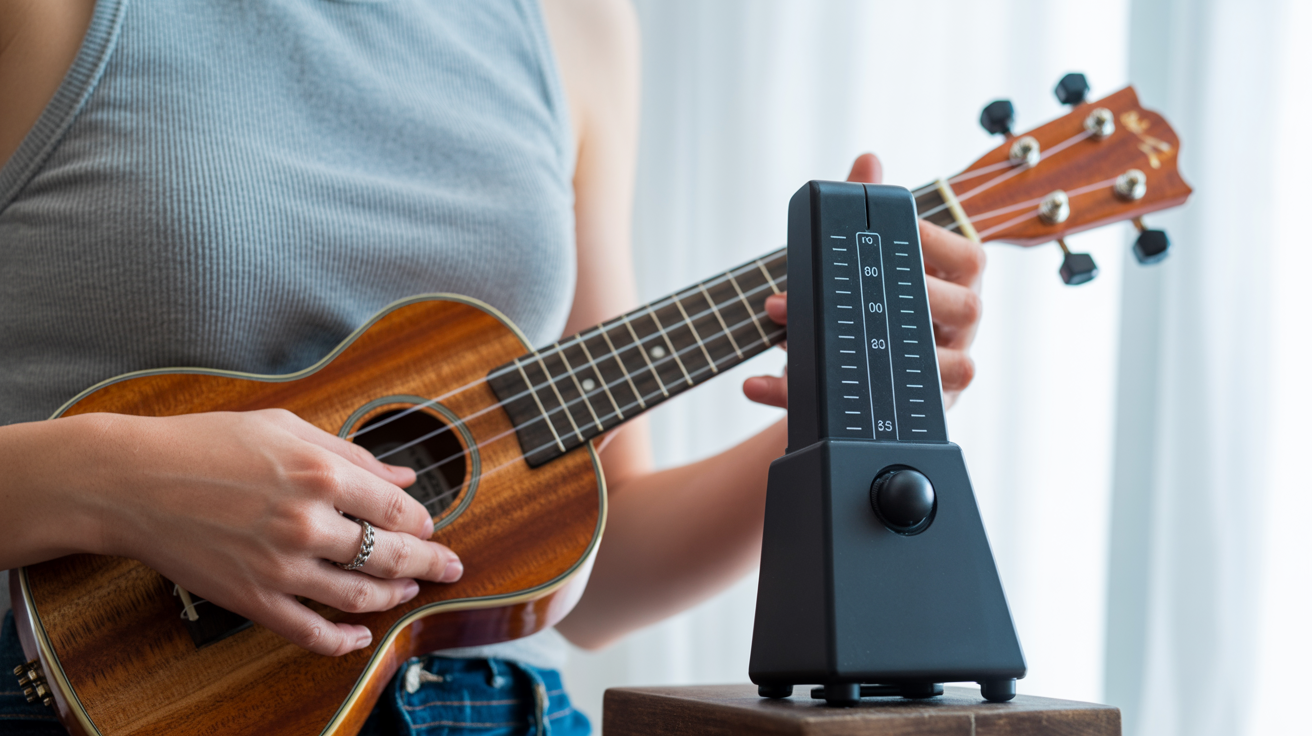
A metronome is one of those tools that looks boring but delivers real results fast. If your strumming speeds up during a chord change, or slows down whenever you hit a tricky spot, a metronome will expose it immediately and help you fix it. This guide walks you through how to actually use one, not just what it is.
What a Metronome Does (and Why It Matters)
A metronome clicks at a steady, consistent tempo. Your job is to play in sync with those clicks.
That sounds simple, but most beginners do not realize how much their tempo drifts while they play. When you slow down to make a chord change, or rush through an easy part because it feels good, you are training your hands to be inconsistent. Playing along to a fixed click forces you to stay steady regardless of what your fingers are doing.
The payoff shows up quickly. Players who practice with a metronome tend to develop better internal rhythm than those who skip it. That internal sense of pulse is what lets you play with other people, keep up with a backing track, or hold a groove through a whole song.
How to Choose a Tempo to Start
The biggest mistake beginners make is setting the metronome too fast. Start slower than you think you need to.
A good rule of thumb: set the tempo at a speed where you can play the passage perfectly at least three times in a row without making a mistake. If you stumble, drop the tempo by 5 to 10 beats per minute (BPM) and try again.
Here is a rough guide for common practice situations:
| Situation | Starting tempo |
|---|---|
| Learning a brand-new chord transition | 50-60 BPM |
| Practicing a strum pattern you know | 70-80 BPM |
| Running through a familiar song | 80-100 BPM |
| Pushing toward performance speed | 90-110+ BPM |
These are starting points, not rules. The right tempo is whatever lets you play cleanly. Speed comes later.
Setting Up a Basic Metronome Practice Session
You do not need a physical metronome. Free apps like Metronome Beats, Pro Metronome, or even a quick web search for "online metronome" will work fine for ukulele practice.
Step 1: Set the time signature. For most ukulele songs and strum patterns, 4/4 time is what you want. Each click represents one beat, and you count four beats per measure: one, two, three, four.
Step 2: Pick your tempo. Start low. If you are working on strumming up and down patterns, try 60 BPM first.
Step 3: Listen before you play. Let the metronome run for a full measure or two before you join in. Find the pulse in your body, tap your foot, nod your head. Join the click instead of dragging it along behind you.
Step 4: Play for 2 to 5 minutes at that tempo. Stay relaxed. If something goes wrong, keep going rather than stopping and restarting. Getting back on track mid-song is a real skill.
Step 5: Increase the tempo gradually. Once you can play cleanly for a full minute at your starting tempo, bump it up by 4 or 5 BPM and repeat. Over several sessions you will cover a lot of ground.
Working on Strumming Patterns With a Click
Strum patterns can feel chaotic without a reference point. A metronome turns them into something you can actually measure and improve.
Pick one pattern and stick with it for the whole session. Do not switch between different rhythms during a single sitting. Repetition is what builds the muscle memory.
When practicing the island strum or any pattern that has upstrokes, pay attention to where your hand is on the off-beats. The upstrokes should land exactly between clicks, not randomly scattered around them. If your upstrokes feel floaty or uneven, slow down until you can feel where they belong.
A useful trick: count out loud while you strum. Say "one-and-two-and-three-and-four-and" along with the metronome clicks while your hand moves. The numbers land on the downstrokes, the "ands" land on the upstrokes. Counting out loud makes timing mistakes impossible to ignore, which is uncomfortable at first and very effective.
Keeping a Steady Beat Through Chord Changes
Chord changes are where most beginners lose the pulse. The natural instinct is to stop strumming for a moment while the fingers move, then restart. That creates a gap, and gaps break the rhythm.
The fix is to keep your strumming hand moving even when the chord is not fully formed. The motion continues; the chord just catches up. This takes practice, but a metronome makes the problem obvious and lets you track your progress.
Try this approach:
- Set a slow tempo, around 50-60 BPM.
- Practice switching between two chords, one strum per beat.
- Do not stop the click, do not stop the strumming hand.
- If the chord is late, notice where the gap happens and slow down another 5 BPM.
As chord changes get smoother, you can add more strums per beat and increase the tempo. The concept in keeping a steady beat while counting goes hand in hand with this: your internal count is what gives the strumming hand something to follow.
Common Metronome Practice Mistakes to Avoid
Practicing too fast too soon. Speed will come on its own once the movements are clean. Pushing the tempo before you are ready just reinforces sloppy habits.
Only using the metronome at the end of practice. Use it from the start, especially when learning something new. That is when habits form.
Stopping every time you make a mistake. When you stop and restart, you are practicing stopping. Keep going when you stumble. Recover and keep the pulse.
Giving up after a few minutes. Timing work feels slow. Stick with one passage for longer than feels comfortable. Ten minutes on one thing beats two minutes on five things.
Frequently Asked Questions
How slow should I set the metronome when starting out?
Slower than you think. If you can play a passage perfectly at 70 BPM, try 60. The goal is to practice the movement correctly, and that is easier at a pace where your hands can keep up without tension. Most players find that starting too slow is never a problem, but starting too fast often is.
Do I need a physical metronome or will an app work?
An app works perfectly well. Free options are available on every major platform and many have additional features like subdivisions and different click sounds. A physical metronome is not necessary for most learners.
How long should I practice with a metronome each session?
Even 10 to 15 minutes of focused metronome practice has a real effect. You do not need to use it for your entire practice time. Use it during the technical parts of your session, such as chord transitions and strum patterns, and then play freely without it to let things settle.
My timing is fine when I play alone. Why do I still need a metronome?
When you play alone without a reference, your brain adjusts what "on time" means in real time. You cannot hear your own drifting the way a listener can. A metronome is an honest, external reference that does not adapt to you. Many players are surprised to discover how much their tempo shifts when they play with a click for the first time.
How quickly will I notice improvement?
Most people notice a difference within a few weeks of consistent practice. The improvement tends to show up first when playing with other people or along to a recorded song, where the external pulse does not give you any room to drift. Keep at it and the steadiness starts to feel natural.