How to Keep a Steady Beat and Count While Strumming
Learn ukulele rhythm for beginners: how to count beats, keep steady timing, and build a pendulum strumming hand that never rushes.

Steady rhythm is the one thing that makes a song recognizable, even if you fumble a chord. A shaky strum that rushes and drags, though, will derail a song no matter how cleanly you fret. The good news: keeping time is a learnable skill, and the method is simpler than most beginners expect. You count out loud, keep your strumming arm moving like a pendulum, and you let a metronome be honest with you.
Why Counting Out Loud Actually Works
Your brain can only hold so many things at once. When you add a new chord, your attention rushes to your fretting hand and your strumming hand goes rogue. Counting out loud takes timing off the mental pile and turns it into a physical habit, your mouth keeps the beat so your hands can focus on technique.
In 4/4 time (the most common time signature in ukulele songs), you count four beats per measure. Each beat can be split in half with an "and," giving you eight even pulses per measure:
1 & 2 & 3 & 4 &
Say it at an even pace, think of a ticking clock. The numbers (1, 2, 3, 4) are the downbeats. The "&" (said "and") lands exactly halfway between them, on the upbeats.
Where the Strums Land
Down-strums fall on the numbers. Up-strums fall on the "&"s. So a simple all-down pattern sounds like:
| Count | Strum Direction |
|---|---|
| 1 | Down ↓ |
| & | (rest) |
| 2 | Down ↓ |
| & | (rest) |
| 3 | Down ↓ |
| & | (rest) |
| 4 | Down ↓ |
| & | (rest) |
When you add up-strums, they slot onto the "&" slots. A classic beginner pattern (down, down-up, up-down-up) maps directly onto this grid, you can see exactly where each strum sits and never have to guess.
The Pendulum Principle
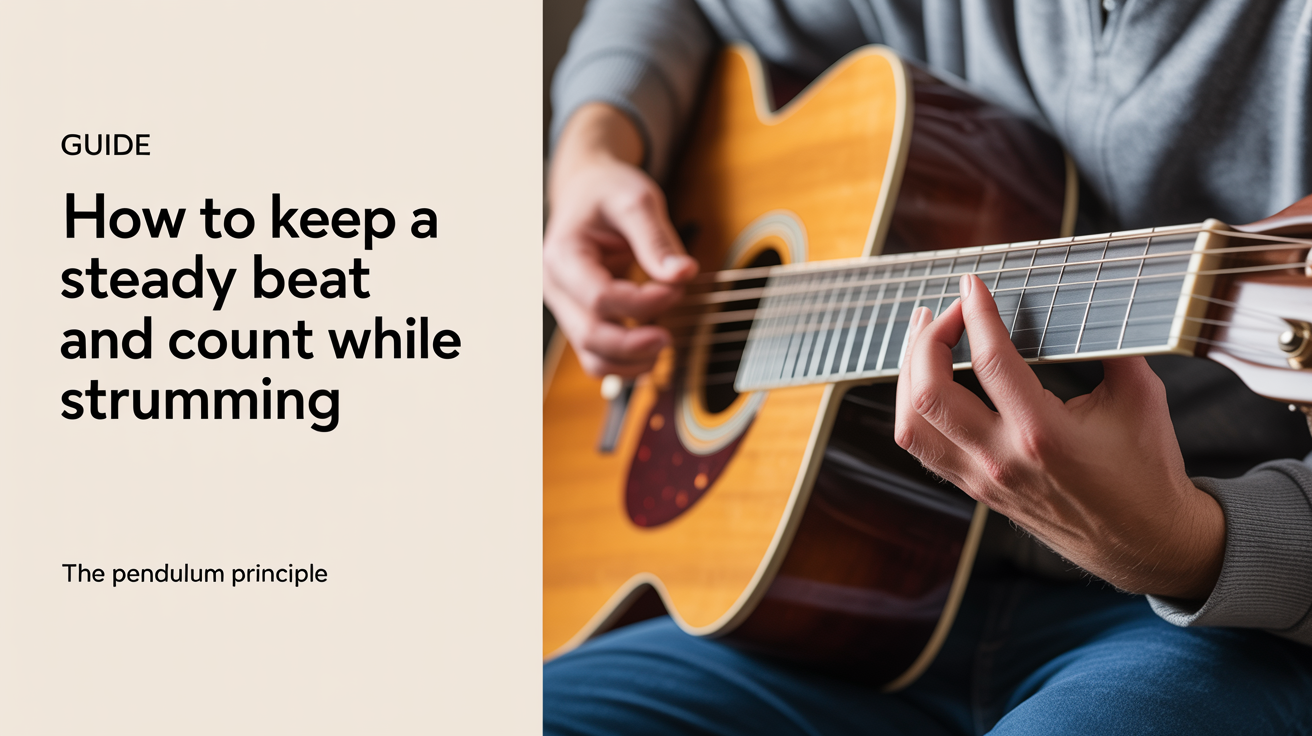
Here is the single most useful idea for ukulele timing: your strumming hand should keep moving even when it does not hit the strings.
Think of your forearm as a pendulum swinging from the elbow. It moves down on every beat and up on every "&," without stopping. Whether your hand grazes the strings or passes through the air is a separate decision. The motion never pauses.
Why does this matter? If your arm stops between strums, you have to restart it each time. That restart takes slightly different amounts of effort each time, and that variation is what creates rushing and dragging. A pendulum that keeps swinging stays consistent.
Try this right now. Hold your ukulele and swing your strumming arm in a smooth down-up-down-up motion, making contact with the strings only on the downstrokes. Count "1 & 2 & 3 & 4 &" as you do it. Notice how the arm never freezes. That continuous motion is the foundation of reliable timing.
For a detailed look at how specific strum patterns build on this pendulum motion, see the guide on how to strum a ukulele up and down patterns for beginners.
Using a Metronome
A metronome tells you the truth. Your internal sense of tempo is optimistic, most beginners play easy parts faster and hard parts slower without realizing it.
Start at 60 bpm. That is one beat per second, which feels almost painfully slow the first time. Stick with it. At 60 bpm you have enough time to think about your arm motion, say the count, and notice when you drift. That information is what rewires your timing over weeks.
How to Practice with a Metronome
- Set the metronome to 60 bpm.
- Let it play for a full measure before you start strumming, so you feel the pulse first.
- Count "1 & 2 & 3 & 4 &" in sync with the clicks, numbers on the click, "&"s exactly between.
- Add your strums. Keep counting out loud.
- If you find yourself rushing, slow the metronome down another 5–10 bpm rather than white-knuckling it at the current speed.
- Only move the tempo up when you can play through an entire minute without drifting.
One trap beginners fall into: speeding up because a section feels comfortable. Comfortable is not the goal during practice. Consistent is. If something feels easy at 60, stay at 60 and make it feel easy 10 times in a row before moving up.
Tapping Your Foot
Your foot is a free metronome. Tap it on every beat, the numbers, not the "&"s, and let it be the anchor while your hand does the more complex work above.
Tap down on 1, 2, 3, 4. Your foot and your down-strums happen at the same time. Your up-strums on the "&" happen as your foot is lifted. Once this becomes automatic, you have an internal reference point you carry everywhere, no phone app required.
It takes a few sessions before the foot tap feels natural rather than distracting. Stick with it. Drummers rely on this body-coordination trick for their entire careers; ukulele players benefit from the same principle at a much smaller scale.
Putting It Together: A Practice Sequence
Here is a simple routine for building steady rhythm from scratch. Run it at the start of any practice session, before you touch your songs.
- 2 minutes: Set metronome to 60 bpm. Tap foot, count "1 & 2 & 3 & 4 &" out loud. No strumming, just get the body in sync.
- 3 minutes: Add all-down strums on beats 1, 2, 3, 4 while counting. Keep the arm swinging through the "&" positions even though you do not strum them.
- 3 minutes: Add up-strums on the "&"s for a full down-up pattern: ↓↑↓↑↓↑↓↑. Keep counting.
- 2 minutes: Try the island strum (D-DU-UDU) at the same tempo. Count the grid: 1 & 2 & 3 & 4 &, hitting D on 1, D on 2, U on &, U on 3, D on &, U on 4. (Silence on beats 1-and and 2-and helps too.)
That 10-minute block will improve your timing faster than an hour of running through songs without counting.
Common Timing Mistakes (and Easy Fixes)
Rushing transitions. When you move from one chord to another, your arm naturally slows, and then speeds up to "catch up." Fix: slow the metronome down until the chord change feels easy, then rebuild tempo gradually.
Stopping the arm between strums. This creates uneven gaps. Fix: practice the pendulum motion alone (no contact with strings) until it feels effortless, then reintroduce string contact.
Counting in your head instead of out loud. Silent counting lets your brain skip the "&"s when things get busy. Fix: count out loud, even if it feels silly. Record yourself if you want proof that you are actually counting on the beat.
Ignoring the metronome click when playing confidently. This is the most common problem for intermediate beginners. You play the easy parts slightly fast and drift away from the click without noticing. Fix: set a quiet click and check in at the start of every measure, does beat 1 still land on the click?
For more patterns that will build on steady timing once you have this foundation, take a look at easy ukulele strumming patterns to learn first.
FAQ
How slow should I start with a metronome?
60 bpm is the standard starting point for timing work. It feels very slow, but that slowness is what lets you actually hear and feel whether you are landing on the beat. Once you can play a full minute without drifting at 60, move up to 65 or 70.
Do I have to count out loud every time I practice?
Not forever, but for the first several weeks, yes. Out-loud counting externalizes the beat and keeps it stable when your attention moves to your hands. Once the timing becomes physically ingrained (you feel when something is off rather than having to think about it), you can drop to silent counting or just the foot tap.
Why does my timing fall apart when I change chords?
Chord changes take processing power, and that processing power is currently coming from the same mental budget as your timing. The fix is not to try harder: it is to slow down until the chord change costs you almost nothing, then gradually rebuild speed. Speed is the reward for mastery, not the method of achieving it.
What is the difference between rushing and being off-beat?
Rushing means your tempo is gradually accelerating, you start at 60 bpm and end the measure at 75 bpm without realizing it. Being off-beat means your note placement is misaligned with the grid (strumming on the "and" when you meant to strum on the beat). Both are common and both are fixed with slow metronome work and counting.
Is tapping my foot really necessary?
Strictly speaking, no, but it is extremely helpful, especially for beginners. The foot tap gives your body a physical anchor for the beat that operates independently from your hands. Many experienced players keep the foot tap for their entire musical life because it makes ensemble playing (playing with other people) much easier.