Easy Ukulele Strumming Patterns to Learn First
Learn the four easiest ukulele strumming patterns for beginners, from all-down strums to the island strum, with beat-by-beat breakdowns.
Strumming patterns trip up more beginners than chord shapes do. You can know C, Am, F, and G by heart, and still sound choppy the moment you try to put a rhythm under them. The good news: there are four simple patterns that cover the vast majority of beginner songs, and each one builds naturally on the last.
Work through them in order. Start on one chord only, C is fine, with a slow metronome. Add chord changes only after the pattern feels automatic.
At a Glance
- Learn the four patterns in order: all-down, down-up, D D DU, and the island strum. Each builds on the motion before it.
- Your strumming hand should swing like a pendulum on every beat, whether or not it actually touches the strings.
- Practice at 50 to 65 beats per minute (bpm) before speeding up. A clean pattern at 60 bpm sounds more musical than a rushed one at 90.
- Counting out loud ("1 and 2 and 3 and 4 and") keeps you honest about where the beat actually falls.
- The island strum alone unlocks a huge share of beginner-friendly songs once it's solid.
- Master a pattern on one chord before adding chord changes; combining a new pattern with new chord shapes at the same time slows both down.
Pattern 1: All Down-Strums (D D D D)
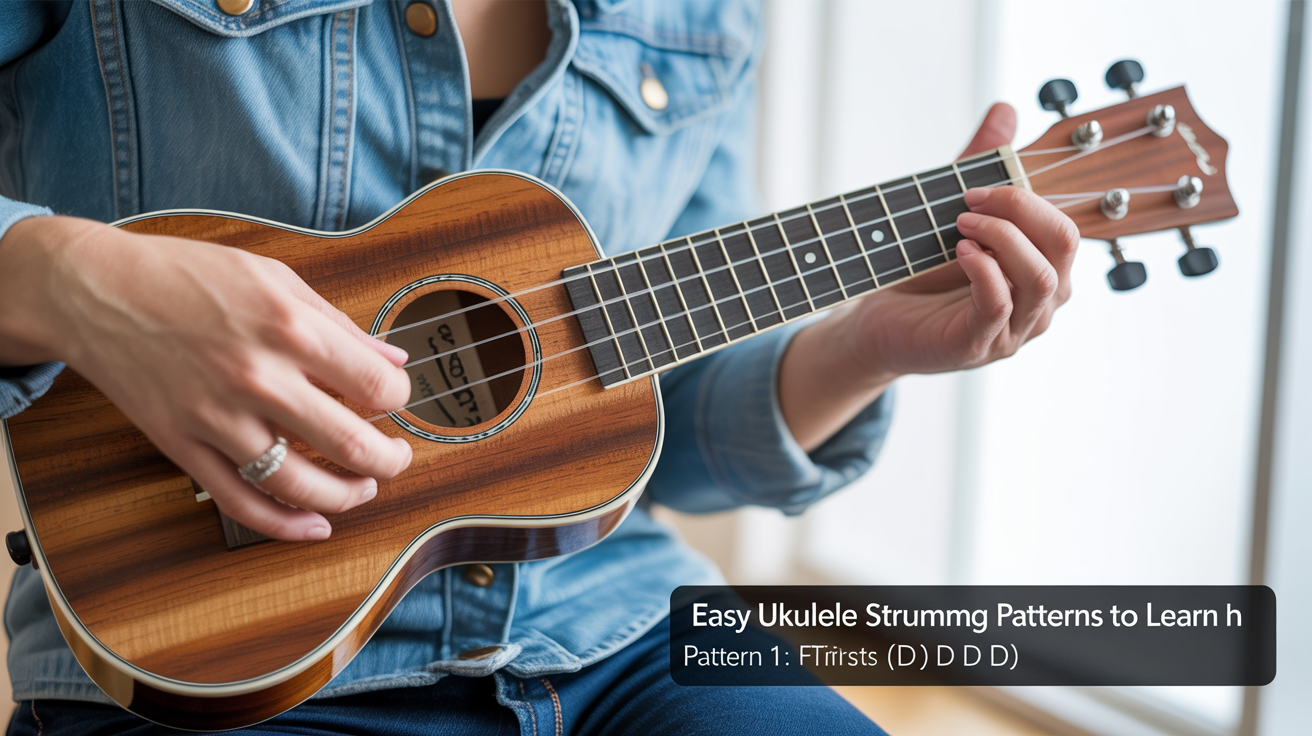
This is exactly what it sounds like. Strum down on beats 1, 2, 3, and 4. Nothing else.
| Beat | 1 | 2 | 3 | 4 |
|---|---|---|---|---|
| Strum | D | D | D | D |
It sounds simple, but it teaches you something genuinely important: keeping your strumming hand moving at a steady pace. Many players speed up when they feel confident and slow down when a chord change is coming. A metronome at 60 to 70 bpm will expose that immediately, which is exactly why it's worth starting here even though the pattern itself is trivial.
Use the pad of your index finger (nail side on the way down) and aim for the strings between the sound hole and the fretboard. That spot gives you a warm, balanced tone without too much brightness.
Stay on this pattern until you can play through four or five chord changes without a gap or a stumble. One bar per chord is a good starting shape. Once it's solid, move on.
Pattern 2: Down-Up on Every Beat (D U D U D U D U)
Now you're going to add upstrokes. Count out loud: "1 and 2 and 3 and 4 and." The downstroke lands on the number, the upstroke lands on the "and."
| Count | 1 | & | 2 | & | 3 | & | 4 | & |
|---|---|---|---|---|---|---|---|---|
| Strum | D | U | D | U | D | U | D | U |
The key is keeping your hand moving like a pendulum, down, up, down, up, without stopping between strums. Even when you're playing the all-down pattern, your hand should still be swinging upward between beats; you're just choosing not to hit the strings on the return. That same pendulum motion is what makes Pattern 2 feel smooth rather than frantic.
Your upstroke only needs to catch two or three strings (the top ones, closest to the floor). You don't need a full-width sweep. If the upstroke sounds thinner than the down, that's completely normal and actually desirable.
Check out how to strum a ukulele up and down patterns for beginners for a deeper look at building this motion correctly before you automate it.
Pattern 3: D D DU (Down on 1, Down on 2, Down-Up on 3)
This is where beginners often feel a click. Pattern 3, sometimes called a "chunka" pattern or a basic pop strum, gives music a sense of lift at the end of the bar. It's the skeleton behind hundreds of folk and pop songs.
Count: "1 and 2 and 3 and 4 and"
| Count | 1 | & | 2 | & | 3 | & | 4 | & |
|---|---|---|---|---|---|---|---|---|
| Strum | D | , | D | , | D | U | , | , |
Beat 4 is silent here. Your hand still swings through the motion, pendulum never stops, but you don't contact the strings on 4 or its "and." That tiny silence is what gives the pattern its bounce.
A common mistake is hitting beat 4 accidentally because the hand is moving and the strings are right there. Practice very slowly and focus on the feeling of your hand passing through beats 4 and "4 and" without touching the strings. Some players lightly rest a finger on the strings at that moment to mute; others just let the swing pass. Try both and pick what works.
Pattern 4: The Island Strum (D, DU, UDU)
This is the pattern. Almost every tutorial, campfire session, and beginning ukulele class eventually lands here. It has a gentle reggae-adjacent lilt that fits ballads, pop songs, and Hawaiian pieces with equal ease.
Count: "1 and 2 and 3 and 4 and"
| Count | 1 | & | 2 | & | 3 | & | 4 | & |
|---|---|---|---|---|---|---|---|---|
| Strum | D | , | D | U | , | U | D | U |
Breaking it down:
- Beat 1: Down
- Beat 2 "and": Up (beat 2 itself is silent, hand swings down without hitting)
- Beat 3 "and": Up (beat 3 itself is silent)
- Beat 4: Down
- Beat 4 "and": Up
The two consecutive upstrokes in the middle ("2 and" and "3 and") are what give the island strum its characteristic lilt. If those upstrokes sound hesitant or uneven, slow down. The pendulum is still moving steadily, you're just changing which passes hit the strings.
The island strum has its own anatomy worth studying once you've got the motion. For now, just repeat it slowly on one chord until the pattern stops requiring active thought.
Pattern Comparison at a Glance
| Pattern | Notation | Difficulty | Starting Tempo | Feel |
|---|---|---|---|---|
| 1: All Down | D D D D | Easiest | 60–70 bpm | Steady, foundational |
| 2: Down-Up | D U D U D U D U | Easy | 50–60 bpm | Smooth, flowing |
| 3: D D DU | D, D, DU,, | Moderate | 50–55 bpm | Bouncy, syncopated |
| 4: Island Strum | D, DU, UDU | Hardest of the four | 45–50 bpm | Lilting, reggae-adjacent |
How to Practice Any Pattern Without Losing Your Mind
A few mechanics that apply across all four patterns:
Metronome first, chords second. Set your tempo so low it almost feels ridiculous, 50 or 60 bpm, and play the pattern on one chord for a full minute. A metronome exists for exactly this purpose: musicians use it to develop and maintain a consistent sense of timing, and a common technique for players who tend to rush is deliberately practicing a phrase at a slightly slower setting each repetition until the tempo feels natural rather than forced. Only add a chord change when the pattern is genuinely automatic.
Count out loud. Counting in your head is easier to fudge. Saying "1 and 2 and 3 and 4 and" out loud forces you to stay honest about where the beat is. It feels awkward for about a week and then becomes second nature.
Keep the pendulum going. Your strumming arm should move at a constant tempo regardless of whether you're hitting the strings. Stopping and restarting the motion between strums is the single biggest source of timing wobble in beginners. Think of your arm as a clock, the swing never pauses.
Know roughly where your tempo sits. Musical tempo is measured in beats per minute (bpm), and while classical tempo markings run from largo (very slow, around 40 to 66 bpm) up through presto (very fast, 168 bpm and beyond), beginner ukulele practice lives almost entirely in that slow end of the range. Starting at 50 to 65 bpm isn't overly cautious; it's roughly where a "moderate" classical tempo marking begins.
Record yourself. Even a phone propped against a wall gives you honest feedback. It's harder to hear your own stumbles in real time than on playback.
For a deeper look at timing specifically, how to keep a steady beat and count while strumming goes into metronome routines and common timing traps worth reading before you move past Pattern 2.
Moving From One Pattern to the Next
There's no fixed timeline. Some players nail the island strum in a week; others spend a month on Pattern 2 before it clicks. What matters is that each pattern is genuinely comfortable before you move on, meaning you can play through a chord progression without the pattern falling apart at the changes.
A practical sequence:
- Pattern 1 at 70 bpm with C–Am–F–G changes, one bar each
- Pattern 2 at 60 bpm, same changes
- Pattern 3 at 55 bpm, same changes
- Pattern 4 at 50 bpm, one chord until the lilt feels natural, then add changes
Once you can play Pattern 4 smoothly at 70 bpm with chord changes, you have the rhythm vocabulary to play a large share of beginner-friendly songs.
FAQ
How long does it take to learn basic ukulele strumming patterns?
Most beginners can get Pattern 1 (all down-strums) feeling steady within the first few practice sessions. Pattern 4 (the island strum) typically takes two to four weeks of consistent daily practice, even 10 minutes a day adds up fast. The honest answer is that "learning" a pattern and truly internalizing it are different things. You want the pattern to happen while your attention is on the music, not on the mechanics. That internalization takes longer than the initial learning, and it only comes from repetition.
Should I use a pick or my fingers for strumming?
Most ukulele players strum with the index finger, nail side going down, flesh side going up. You'll hear different opinions on pick use; some players like a felt pick for a softer sound. There's no wrong answer, but starting with your finger gives you better feedback about how hard you're hitting the strings and makes it easier to adjust tone on the fly.
Why do my upstrokes sound thin or scratchy?
Upstrokes on ukulele naturally catch fewer strings than downstrokes, so a slightly thinner sound is expected. If they sound scratchy, you may be catching the strings at an angle with your nail rather than grazing them lightly with the flesh of your fingertip. Try relaxing your wrist and letting the upstroke be lighter overall. You're aiming for a brush, not a scrape.
Can I play songs with just these four patterns?
Yes, genuinely. Most beginner ukulele songs fit comfortably into one of these four patterns, and Pattern 4 alone opens up a huge repertoire. More complex patterns exist, muted strums, fingerpicking, split strokes, but you won't need them for a long time. Master these four first and you'll have a solid rhythmic foundation to build on.
What tempo should I start at?
Slower than you think. Set your metronome to 50 to 65 bpm and play there until the pattern is clean, then nudge it up by 5 bpm at a time. The goal isn't to play fast; it's to play evenly. A clean pattern at 60 bpm sounds far more musical than a lurching one at 90.
My strumming hand freezes up when I try to add the upstrokes. What's going wrong?
This almost always means the pendulum motion stopped somewhere along the way. Go back to Pattern 1 and consciously let your hand keep swinging upward between the down-strums, even though you're not hitting the strings on the way up. Once that continuous motion feels automatic, layering in the actual upstrokes for Pattern 2 becomes a small adjustment instead of a new skill from scratch.
Do I need to memorize the counting numbers, or can I just feel the rhythm?
Both skills matter, but count out loud first. Feeling a rhythm is the eventual goal, and plenty of experienced players never think in numbers while performing. But when you're first learning where the silences fall in patterns like the chunka strum or the island strum, counting out loud is the fastest way to locate exactly which beat you're missing. Once a pattern is solid at a given tempo, the counting naturally fades into the background and the feel takes over on its own.