How to Find the Right Key and Use a Capo on Ukulele
Learn how a capo works on ukulele, how to use one to change keys, and when transposing makes songs easier or more comfortable to sing.
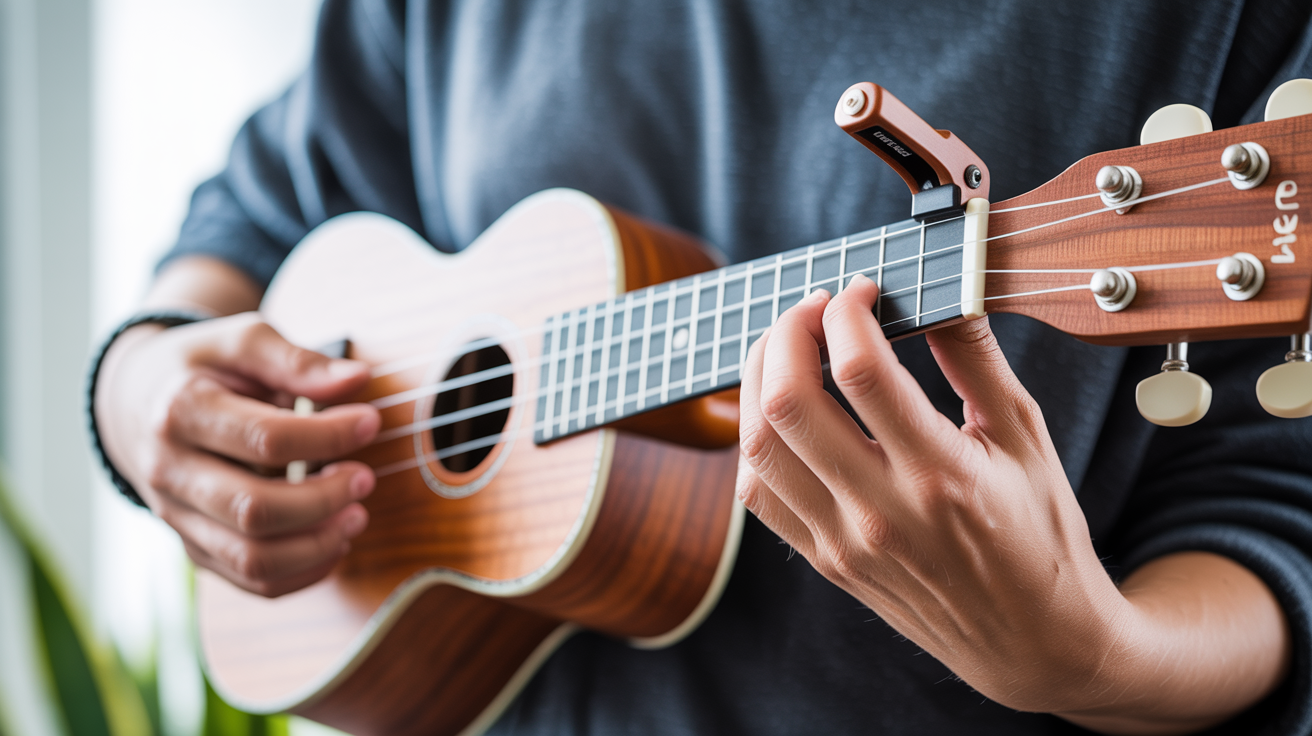
A capo is a small clamp you place across the fretboard. Clip it on, and every open string sounds higher. That one change can make a song fit your voice better, turn a set of hard chords into easy ones, or let you play along with a recording that sits in a key your current chord shapes do not reach.
If you have never used a capo before, the concept clicks quickly. Here is everything you need to get started.
What a Capo Actually Does
When you play an open C chord, the strings vibrate from the nut (the little slotted piece at the top of the neck) all the way down to where your fingers press. Clamping a capo at the second fret effectively creates a new nut at that position. Your fingers still make the same C chord shape, but the strings are shorter now, so the sound comes out higher.
Each fret raises pitch by one half step. Capo at fret 1 raises everything one half step. Capo at fret 2 raises it a whole step, and so on. The chord shapes stay identical; only the key changes.
This matters for two reasons:
- Vocal range. A song may be written in a key that sits just a little too high or too low for your voice. Moving the capo up or down a fret or two can land you exactly in the sweet spot.
- Chord difficulty. Some keys call for awkward barre chords or uncommon shapes. If you can play the same song with a capo using chords you already know, there is no reason not to.
Choosing a Capo for Ukulele
Not all capos fit all instruments. Guitar capos are designed for a wider, flat or curved fretboard. A standard soprano, concert, or tenor ukulele has a narrower neck with a different radius, so a ukulele-specific capo will press all four strings evenly without buzzing or going sharp.
A few things to look for:
- Spring-loaded clamp style. These are the most common and work well for uke. Squeeze, position, release.
- Tension adjustment. Some have a screw to dial in how hard the bar presses. Lighter tension is usually enough for nylon strings.
- Partial capos. These cover only some strings. They are a creative tool, but not something you need to worry about as a beginner.
Avoid the cheapest unbranded options; a capo that presses unevenly will throw your tuning off every time you clip it on.
How to Use a Capo on Ukulele
Placing a capo takes about ten seconds once you know the routine:
- Decide which fret you need (more on that below).
- Open the capo and slide it behind the fret wire, not on top of it. The bar should sit just behind the metal fret, toward the tuning pegs.
- Close or release the clamp so it grips all four strings.
- Pluck each open string. Every string should ring cleanly with no buzz and no noticeable sharpness.
- If a string buzzes, nudge the capo slightly closer to the fret wire. If strings sound sharp, the tension may be too high or the capo is placed too close.
After clamping, check your tuning. Capos can pull strings slightly sharp, especially on cheaper instruments. A quick check with a clip-on tuner takes five seconds and is worth the habit.
Finding the Right Key for Your Voice
This is where most beginners get confused, so let us walk through it step by step.
Step 1: Find the key of the song.
The song you want to play is written in some key. If you found chords online, the page or video often lists the key in the title or description. If not, the first chord of a verse is usually, though not always, the home chord.
Step 2: Sing along and find your comfortable range.
Play the song in its original key and sing. Notice whether it feels comfortable, or whether you are straining at the top or reaching down lower than feels natural. If the song feels slightly too high, you want to move the key down. If it is too low, move it up.
Step 3: Use the capo to shift up, or transpose the chords to shift down.
A capo only moves pitch upward. To raise the key, clip the capo higher on the neck and play the same chord shapes. To lower the key, you cannot use a capo; instead you need to transpose the chords themselves (replace each chord with one that sits a half step or whole step lower).
For most beginners, the capo is the more practical tool because it avoids having to learn new chord shapes on the spot.
A Quick Fret Reference
| Capo Fret | Key Change |
|---|---|
| 1 | +1 half step (e.g., C chords sound as C#) |
| 2 | +1 whole step (C sounds as D) |
| 3 | +1.5 steps (C sounds as Eb) |
| 4 | +2 whole steps (C sounds as E) |
| 5 | +2.5 steps (C sounds as F) |
You rarely need to memorize this table. If the key feels one step too low, try capo 2. If it is still not quite right, move it. Trust your ear.
Transposing Songs Without a Capo
Sometimes you want to play in a different key but do not have your capo handy, or you simply want to understand the chord relationships involved. That is where transposing comes in.
Transposing means replacing each chord in a song with a chord that sits the same number of half steps up or down. There are two practical ways to do this as a beginner:
Use a chord wheel or transposing chart. A simple chart lists the 12 keys in a circle. Pick your original key, count the steps you want to move, and read off the new chords.
Use the Nashville Number System lightly. This approach labels each chord in a key with a number (1 through 7). Once you know that a I chord (home) in C is C, and in G is G, moving a song between keys is just a matter of swapping the numbers. This sounds more theoretical than it is in practice.
For most beginners, the capo handles 90 percent of key-change situations. Transposing by hand is a useful skill to develop gradually, not something you need to tackle on day one.
Learning to read tablature alongside chord charts opens up more song options. If you have not done that yet, take a look at how to read ukulele tabs for a quick primer.
Practical Tips When Playing Songs in Different Keys
A few things that help once the capo is in place:
- Treat the capo as the new nut. When someone asks what chord you are playing, name the chord shape you are using, not the sounding pitch, unless you specifically need to communicate the actual key.
- Check intonation up the neck. Some ukuleles have slight intonation drift as you move up the frets. If notes sound off even with a capo, a quick setup from a repair shop can fix it.
- Keep your capo accessible. If you are playing songs back to back in different keys, clip the capo loosely to a tuning peg when you are not using it so it is always within reach.
- Experiment freely. Moving the capo one fret costs you nothing. Try a few positions and see which key makes the song feel most natural under your fingers and in your voice.
Once you have a handle on keys and the capo, songs become much more flexible. The same chord shapes you learned for easy first songs on the ukulele can now cover a wider range of material. And when you are ready to sing along while you play, having the key locked in ahead of time makes everything easier. Check out how to play and sing at the same time on the ukulele once your chord transitions feel steady.
Frequently Asked Questions
Do I need a capo to play ukulele?
No. Plenty of songs sit comfortably in the ukulele's standard tuning. A capo is a convenience tool, not a requirement. It becomes more useful once you start wanting to sing along and discover that a song does not quite fit your voice in its written key.
Will a guitar capo work on a ukulele?
Often not well. Guitar necks are wider and have a different curvature. A guitar capo may press only the middle strings on a uke, leaving the outer strings buzzing or unmuted. A capo sized for ukulele is the safer choice.
How do I know which fret to put the capo on?
The simplest method: play the song in its original key and sing. If your voice feels too low and you want the song higher, move the capo up one fret at a time until it sits comfortably. There is no formula you need to memorize. Your ear is the best guide.
Can I use a capo on a baritone ukulele?
Yes, though baritone ukes are tuned differently from soprano, concert, and tenor models (the baritone is tuned DGBE, like the top four strings of a guitar). The capo still works the same way mechanically. Just make sure the capo you buy is wide enough for the baritone's slightly wider neck.
Does using a capo mean my chord shapes change?
No, that is exactly the point. Your left hand makes the same shapes it always has. The capo does the work of raising the pitch. The chord names that result from those shapes change (a C shape with a capo at fret 2 sounds as a D chord), but your fingers do not have to learn anything new.