How to Play a Minor Chord on Ukulele: Am, Em, and Dm
Learn to play Am, Em, and Dm on ukulele with clear finger placement, plain explanations, and practice tips for smooth chord switching.
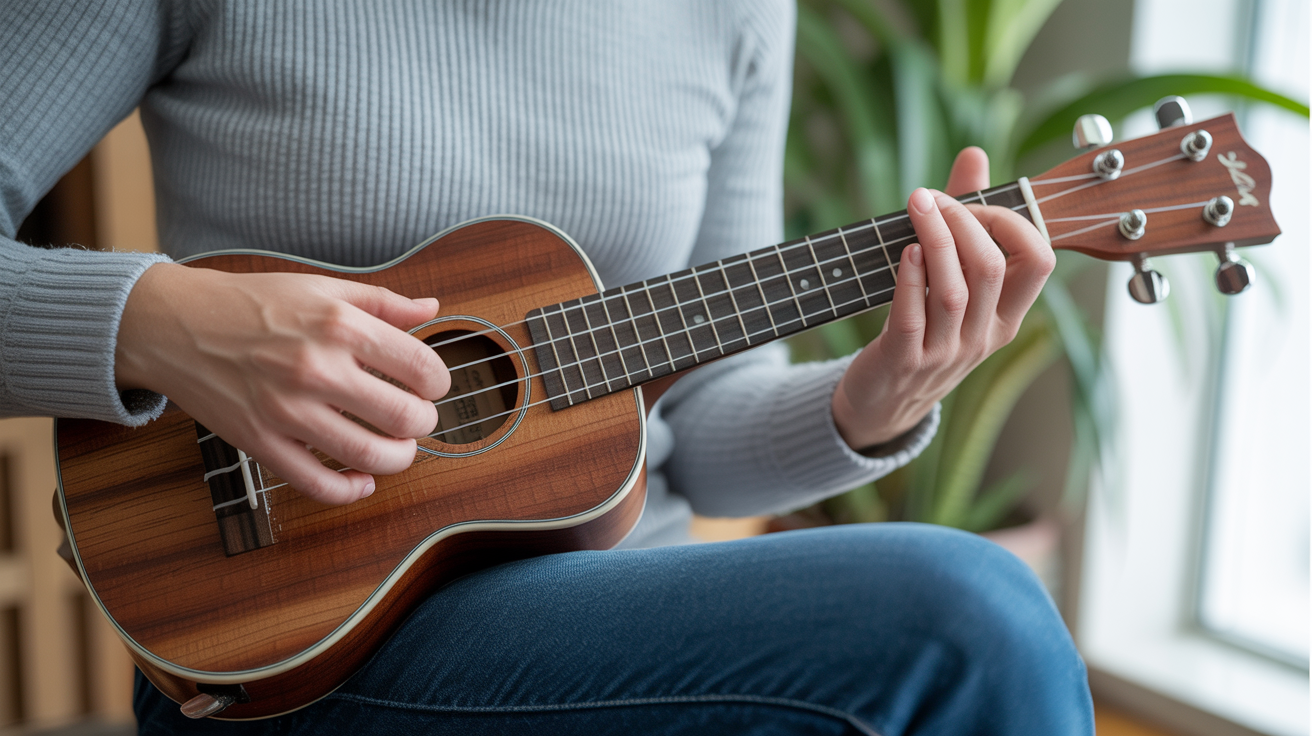
Minor chords carry weight. They pull a song inward, add a touch of sadness or tension, and make the major chords that follow feel even brighter by contrast. Three minor chords cover an enormous range of songs you probably already know: Am, Em, and Dm. This guide walks through each shape, explains what makes minor chords sound the way they do, and gives you a practical way to start using them right away.
At a Glance
- Am, Em, and Dm are the three minor chords you'll meet first, and together they unlock a large share of beginner song charts.
- Am uses one finger and is usually the easiest minor chord to learn first.
- Em is the widest stretch of the three; take it slow and don't force your hand.
- Dm crams two fingers onto the same fret on adjacent strings, which feels cramped before it feels normal.
- The only difference between a major and minor triad is a one-half-step shift in the middle note of the chord.
- Short, frequent practice sessions build chord-switching speed faster than occasional long ones.
Why Minor Chords Sound Different from Major Chords

You do not need music theory to play ukulele, but a simple explanation helps you make sense of what your fingers are doing.
Every chord is built from a combination of three notes called a triad. The distance between those notes determines the mood. In a major chord, the middle note sits four half-steps above the root. In a minor chord, that same middle note drops down one half-step, to three half-steps above the root. That single shift is the entire difference. Major chords sound bright and open. Minor chords sound darker and more introspective.
On a ukulele, you produce that difference just by changing where one or two fingers land on the fretboard. The shapes are not harder than major chords; they are just different shapes. With a little practice, your hand learns them as muscle memory the same way it learned C, F, or G7.
If you are still building up your basic shapes, the guide on the first ukulele chords to learn is a useful starting point, and it already covers Am in that context.
How to Play Am (A Minor)
Am is often the first minor chord beginners encounter, partly because its shape is so clean.
Am chord (standard GCEA tuning)

String:  G  C  E  A
Fret:    2  0  0  0
Finger:  2  -  -  -
Place your middle finger (finger 2) on the second fret of the G string. The C, E, and A strings ring open. That is the whole chord.
Strum from the G string downward and listen to the sound. It is noticeably different from C major, which also uses just one finger. The single fretted note changes the chord's identity completely.
Common trouble spots:
- Make sure your middle finger is pressing firmly and lands close to the second fret, not halfway between frets. If the note buzzes, inch your finger toward the metal fret wire.
- Do not accidentally mute the C string with your fretting finger. Keep your knuckles arched so your finger tip contacts only the G string.
- If the chord still sounds muddy after adjusting your finger, check your thumb. A thumb pressed too far up the back of the neck tends to flatten the rest of your hand and drag other fingers into strings they should not touch.
Am appears in hundreds of songs, often moving back and forth with C, F, and G7. You already have three of those four chords if you have been playing for a short while.
How to Play Em (E Minor)
Em uses two fingers and sits higher on the neck.
Em chord (standard GCEA tuning)

String:  G  C  E  A
Fret:    0  4  3  2
Finger:  -  3  2  1
Place your index finger (finger 1) on the second fret of the A string, your middle finger (finger 2) on the third fret of the E string, and your ring finger (finger 3) on the fourth fret of the C string. The G string rings open.
That is a stretch compared to Am or C. Take your time and do not force your hand into position. If your wrist aches, back off and try again with your elbow slightly further from your body, which lets your wrist relax and your fingers reach.
Common trouble spots:
- The C string fret (4th fret) is the one most players struggle to reach cleanly. Practice placing ring finger first, then building the rest of the shape around it.
- Strum slowly on the first try. Confirm all four strings ring without buzzing before you try to switch in and out of the chord.
- If your hand cramps before all three fingers land, break the shape into two steps for a week: place the index and middle fingers together first, pause, then add the ring finger. Rejoin the steps once each half feels automatic.
Em is less common in beginner song charts than Am or Dm, but it appears in songs that want a particularly tense or wistful sound. Once your hand is comfortable with the stretch, the chord becomes reliable.
How to Play Dm (D Minor)
Dm has a distinctive spread-out shape that many beginners find tricky at first.
Dm chord (standard GCEA tuning)

String:  G  C  E  A
Fret:    2  2  1  0
Finger:  3  2  1  -
Place your index finger (finger 1) on the first fret of the E string, your middle finger (finger 2) on the second fret of the C string, and your ring finger (finger 3) on the second fret of the G string. The A string rings open.
The G and C strings share the second fret but are played by different fingers side by side. This can feel cramped at first. A slight downward tilt of your wrist (bringing the back of your hand forward) often opens up enough room for both fingers to land cleanly.
Common trouble spots:
- Finger 2 and finger 3 need to avoid touching each other's strings. Keep them as upright as possible.
- The A string must ring open and free. Watch that your ring finger does not accidentally brush it.
- If your fingers feel stacked on top of each other, try angling finger 3 (on the G string) slightly toward the headstock and finger 2 (on the C string) slightly toward the bridge. That small offset gives each fingertip its own lane.
Dm shows up constantly in songs written in F major and D minor. Once you have it, you unlock a significant portion of the popular song catalog. The guide on how to place your fingers for clean ukulele chords covers the mechanics of finger placement in detail if you want to troubleshoot buzzing or muted strings more broadly.
Quick Reference: All Three Shapes Side by Side
| Chord | Fingers needed | Strings fretted | Trickiest part |
|---|---|---|---|
| Am | 1 (middle) | G string only | Not muting the C string |
| Em | 3 (index, middle, ring) | A, E, C strings | The wide stretch across three frets |
| Dm | 3 (index, middle, ring) | E, C, G strings | Two fingers sharing the second fret |
Notice the pattern: Am is the shortcut minor chord, one finger and done, while Em and Dm both ask for a three-finger shape but in different, non-overlapping ways. Learning Am first, then Dm, then Em, tends to feel like the gentlest ramp for most beginners.
Practice Exercises for Minor Chords
Having the shape is one thing. Switching to it mid-song is another. Here are a few focused exercises to build that fluency.
Exercise 1: Am to C and back
Am and C share the same family of chords in the key of C major. Many songs use both. Practice going Am, C, Am, C at a comfortable pace. Notice that the switch is just a matter of moving one finger from the second fret of the G string (Am) to the third fret of the A string (C). Your hand barely moves.
Exercise 2: Dm to F
Dm and F appear together constantly. The shapes look different but are spatially close on the neck. Go Dm, F, Dm, F slowly, then speed up over several sessions. Keep a metronome on or tap your foot. A useful benchmark: once you can hold a steady 60 beats per minute with one full chord change per beat, for 8 changes in a row with no buzzing, move the metronome up by 10.
Exercise 3: Am, Dm, Am, C, F, G7
This six-chord rotation covers the I, IV, and VI chords in C major (C, F, Am) plus the IV minor relative (Dm). You can play recognizable chord progressions in multiple songs with just these shapes. Start at a pace where no chord change makes you panic.
For a focused look at making chord changes smoother and more automatic, the guide on how to switch between ukulele chords smoothly goes into the techniques in more depth.
A note on practice sessions: Short, frequent sessions build muscle memory faster than one long session per week. Ten minutes a day beats seventy minutes once a week. Your fingers need repetition, and they consolidate the shapes overnight. This lines up with what researchers studying motor-skill acquisition have found in unrelated fields, spacing practice out across several days trains a skill more efficiently, and the skill holds up better weeks later, than cramming the same total time into one sitting.
Frequently Asked Questions
Do minor chords on ukulele require more finger strength than major chords?
Not really. Most beginner minor chords on ukulele use the same amount of pressure as major chords. Em requires a wider stretch across three consecutive frets, which is more about flexibility than strength. That comes with time, not with squeezing harder.
Why does Am sound so different from C if both use just one finger?
The fretting finger lands on a different string, which changes which notes sound across the four strings. C major frets the A string at the third fret, producing a C-E-G-C combination. Am frets the G string at the second fret, producing A-C-E-A. Same number of fingers, completely different set of notes, completely different mood.
Can I play songs in a minor key using only these three minor chords?
Yes, many songs in A minor or D minor are fully playable using Am, Dm, Em plus a couple of major chords like C, F, and G. Once you have the minor shapes down, experimenting with simple minor-key chord progressions is a satisfying next step.
My Dm chord buzzes no matter what I do. What should I try?
First, check that your fingers are landing close to the fret wire rather than midway between frets. Second, check that no finger is accidentally touching an adjacent string. Third, try adjusting your thumb position on the back of the neck so it sits roughly behind the middle finger. A slight wrist rotation often helps. If the buzz persists, an older or thicker string set can sometimes be the culprit.
How long does it take to switch between minor and major chords without thinking?
This varies by how often you practice, but most beginners find that consistent daily practice over two to four weeks makes common transitions feel natural. Am to C is one of the fastest transitions to automate because the finger movement is small. Dm to F and Em to C take a bit longer because the shapes are further apart on the neck.
Is there an easier alternative shape for Dm if the stretch bothers me?
Some players fret Dm with finger 1 on the C string and finger 2 on the G string instead of index-middle-ring across three strings, which shortens the stretch slightly, though the fret positions themselves do not change. If your hand is still small, it can also help to practice Dm in isolation, without switching into or out of it, until the shape itself feels settled before you add motion.
What minor chord should I learn after Am, Em, and Dm?
Bm and F#m come up next most often, particularly if you start exploring songs in the key of G or D. Both require a small barre, similar in spirit to the Bb chord in the key of F, so they are a natural next step once your fretting hand is comfortable holding down more than one string at a time.